

- Tassadaq
- Aug 04, 2025
- latest updates
Get Your Original Japanese Auction Sheet for Just Rs. 1,250
Enter your chassis number and we'll check auction sheet availability for free. If the original Japanese auction sheet is found, you can get it for just Rs. 1,250. No payment is required unless the sheet is available.
Buying a Japanese imported car in Pakistan without verifying its auction sheet can be a costly mistake. A fake auction sheet may hide accident history, tampered mileage, or major repairs, leaving buyers with unexpected expenses. At SpotMV, our Auction Sheet Verification service helps you confirm the original auction report using the vehicle's chassis number so you can purchase with complete confidence.
In this blog, we’ll explore what an auction sheet is, how to read it, and most importantly, how to verify it online, especially through free auction sheet verification online in Pakistan tools. We’ll also explain how SpotMV makes this entire process simple and trustworthy.
What is a Japanese Auction Sheet?
A Japanese auction sheet refers to a comprehensive report prepared by car auction houses in Japan. It gives the critical details of a vehicle on auction, such as the following:
- Make and model
- Year of production
- Mileage (odometer)
- History of accidents and repair
- Outside and inside state
- Immobilizer status (Engine and transmission)
- Auction grade (general vehicle rating)
Japanese auction inspectors carefully examine every vehicle before assigning its auction grade and preparing the official inspection sheet. Since auction houses rely on transparency and trust, the information is generally considered reliable.
Why Auction Sheet Verification is Important in Pakistan
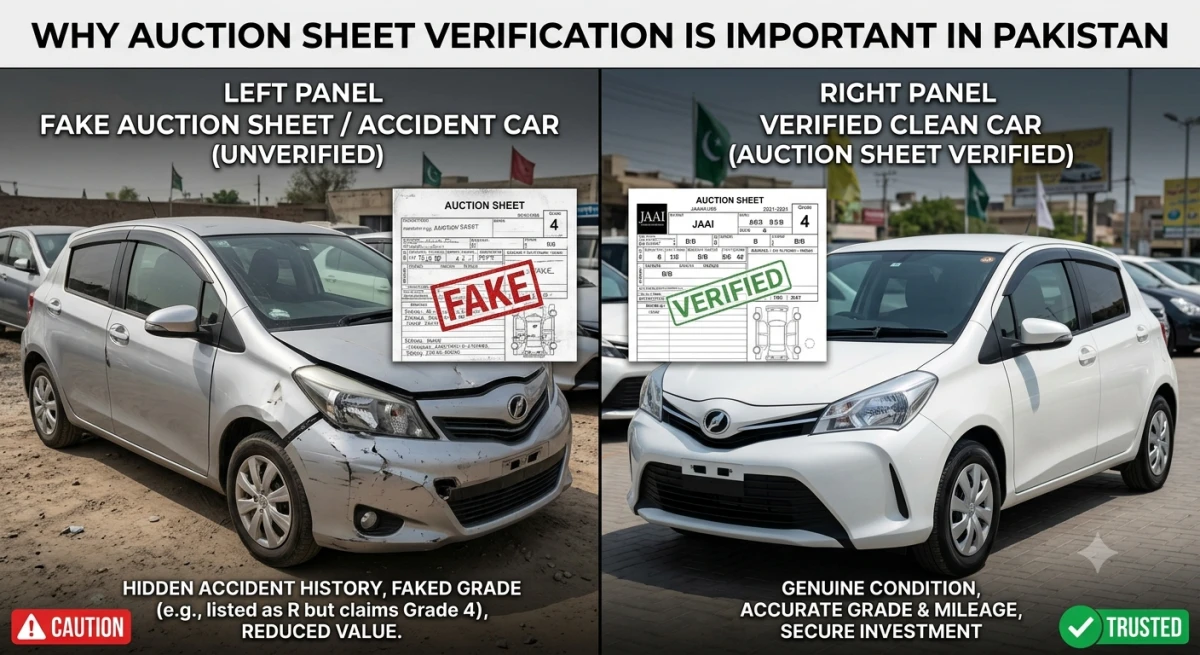
In Pakistan, it is common that the auction sheets are changed or falsified by many importers and dealers to cover the actual state or mileage of a vehicle. There are cars that were in accidents or odometers rolled back and are sold as genuine or grade 4 cars.
And this is the reason why you have to check:
- Never purchase cars that have been damaged in an accident
- Avoid paying a premium for a lower-grade car
- Discover mileage fraud
- Get a decent bargain
Make an informed buying decision and negotiate a fair price.
You are virtually making a blind purchase with no verification.
What Information Does a Japanese Auction Sheet Contain?
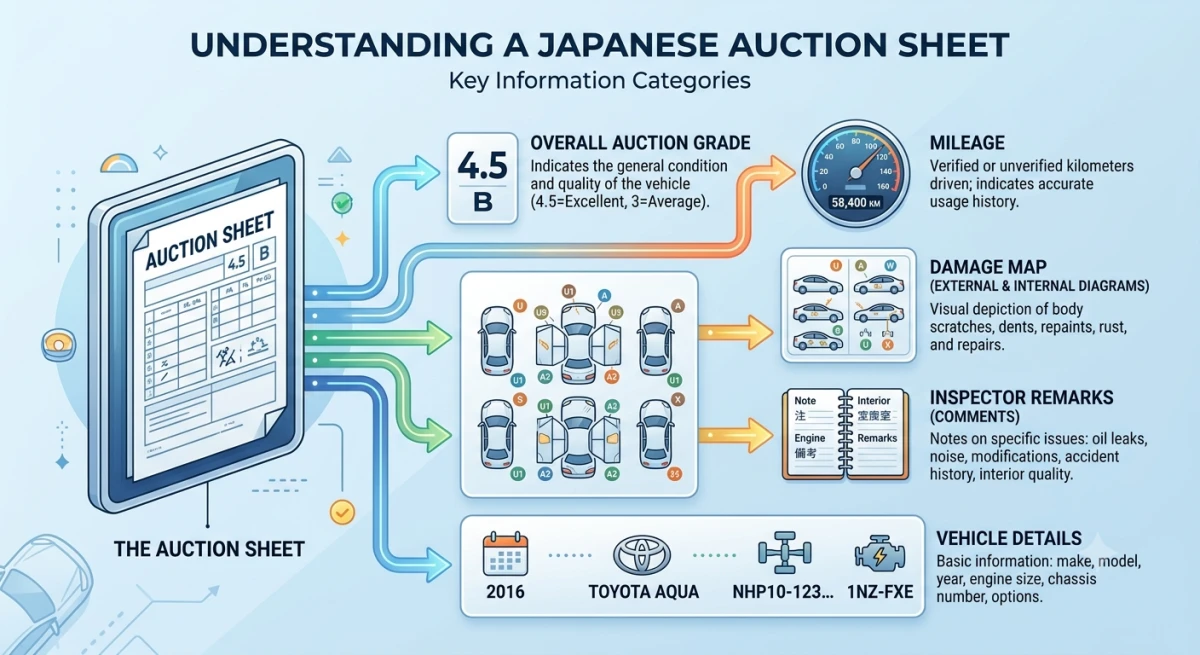
If you're planning to import a used car from Japan or buy one that has already arrived in Pakistan, understanding the Japanese auction sheet is essential. This document serves as a professional inspection report created before the vehicle is sold at a Japanese auction. It gives buyers a transparent overview of the car's condition, helping them avoid hidden issues and make confident purchasing decisions.
Unlike a simple vehicle listing, a Japanese auction sheet includes detailed information about the car's mechanical condition, exterior, interior, mileage, repair history, and auction grade. Learning how to read this document can save you from expensive surprises later.
Auction House Details
Every auction sheet begins with basic information about the auction itself. This section identifies where and when the vehicle was sold.
It typically includes:
- Auction house name
- Auction date
- Lot number
- Auction lane number
These details help verify that the auction sheet belongs to the correct vehicle.
Overall Auction Grade
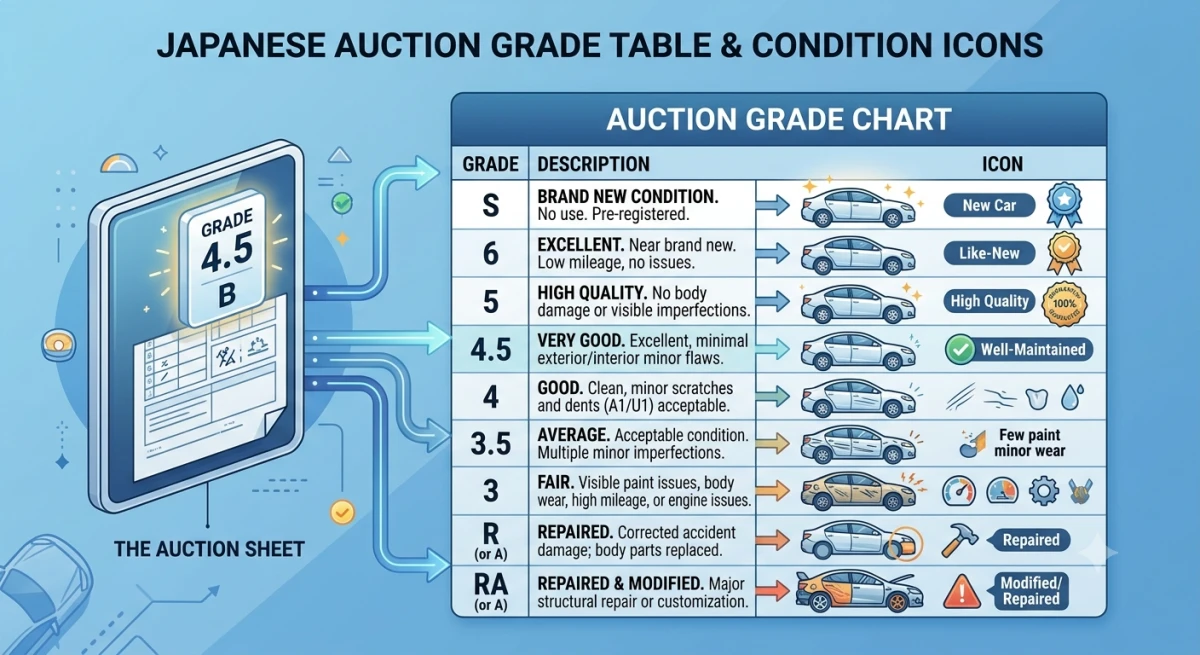
The auction grade provides a quick summary of a vehicle's overall condition after inspection by the auction house. While grading standards may vary slightly between auction houses, the following grades are commonly used.
| Grade | Condition |
|---|---|
| S | Nearly new vehicle with extremely low mileage |
| 6 | Excellent condition |
| 5 | Very clean used vehicle |
| 4.5 | Excellent overall condition |
| 4 | Good condition with normal wear |
| 3.5 | Average condition with noticeable imperfections |
| 3 | Fair condition, may require repairs |
| R / RA | Repaired accident vehicle |
| A | Accident history reported |
Tip: The auction grade provides a quick overview, but buyers should always review the inspector's remarks and damage diagram before making a purchase.
Auction Grade Explained (S, 6, 5, 4.5, 4, 3.5, 3, R, RA, A)
Grade S
Almost new. Very low mileage and excellent condition.
Grade 6
Excellent condition with minimal wear and low mileage.
Grade 5
Very clean used car with no major issues or accident history.
Grade 4.5
Well-maintained vehicle with only minor scratches or wear.
Grade 4
Good condition with normal signs of everyday use.
Grade 3.5
Average condition with noticeable wear and small cosmetic defects.
Grade 3
Fair condition. May need cosmetic or mechanical repairs.
Grade R
Vehicle has been repaired after structural or accident damage.
Grade RA
Minor structural repairs have been carried out. Check the inspection report carefully.
Grade A
Vehicle has an accident history or recorded damage. Always review the auction sheet before buying.
Interior Condition Grade
In addition to the overall grade, inspectors evaluate the cabin and assign a separate interior grade.
Common ratings include:
- A – Excellent interior
- B – Good condition with light wear
- C – Average condition showing regular use
- D – Poor condition requiring attention
This helps buyers understand whether the seats, dashboard, carpets, and interior trim have been well maintained.
Vehicle Specifications
The auction sheet contains the vehicle's technical information, making it easy to confirm that the car matches the seller's description.
Typical specifications include:
- Manufacturer
- Model
- Year of manufacture
- Chassis number
- Engine displacement
- Fuel type
- Transmission
- Drive type (2WD or 4WD)
- Exterior color
- Registration date
These details are useful for confirming the exact variant before purchase.
Odometer Reading
Mileage is another important part of the auction sheet. Japanese auction inspectors record the vehicle's odometer reading at the time of inspection.
If there is any doubt about the accuracy of the mileage, the auction house usually marks the reading accordingly. This protects buyers from vehicles with questionable odometer histories.
Factory Features and Equipment
Most auction sheets include a checklist of factory-installed equipment and optional features.
Depending on the vehicle, you may find:
- Air conditioning
- Power steering
- Power windows
- Airbags
- ABS brakes
- Navigation system
- Push-start ignition
- Smart key
- Alloy wheels
- Cruise control
- Sunroof
- Parking sensors
- Rear or 360-degree camera
These features help buyers compare different vehicles before bidding.
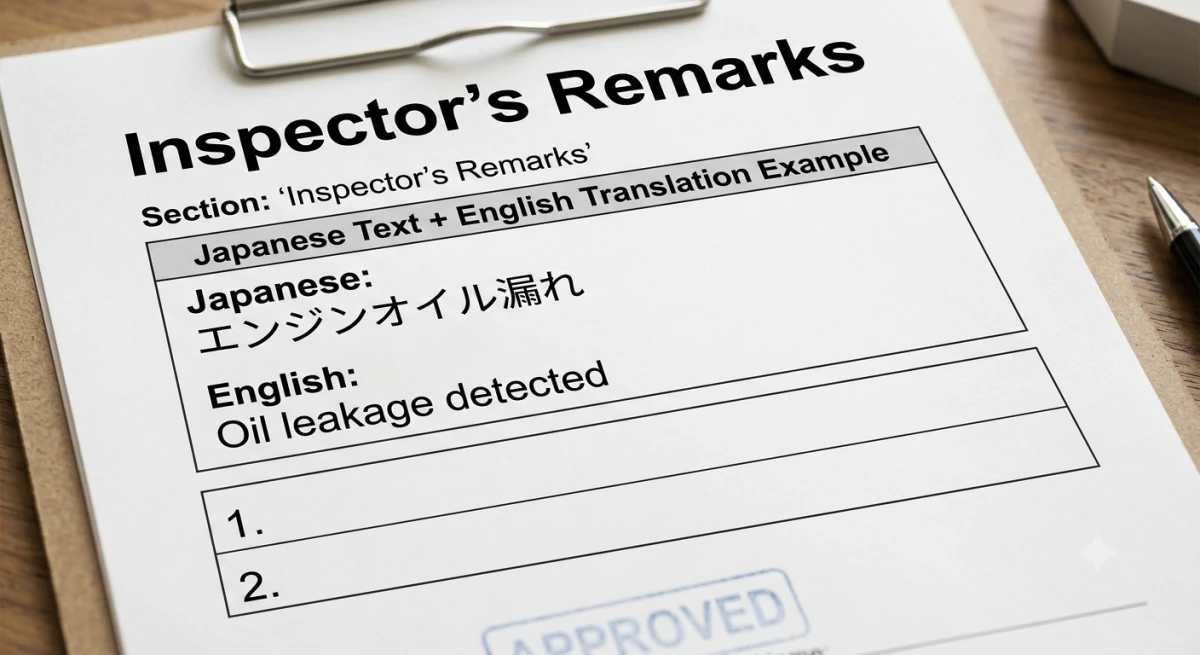
Inspector's Remarks
One of the most valuable sections is the inspector's comment area.
Rather than assigning only a grade, inspectors also write observations about the vehicle's condition. These remarks often mention issues that cannot be fully represented by the grading system.
Comments may include:
- Engine performance
- Transmission condition
- Oil leaks
- Rust or corrosion
- Warning lights
- Suspension problems
- Exhaust smoke
- Interior wear
- Required repairs
Since these notes are usually written in Japanese, many buyers use professional translation services before making a purchase.
Vehicle Damage Map
Japanese auction sheets include a simple outline of the vehicle showing its body panels. Inspectors mark scratches, dents, repaired areas, and replaced panels using standardized symbols.
Some common symbols include:
| Symbol | Meaning |
| A1–A3 | Scratch |
| U1–U3 | Dent |
| W1–W3 | Repaired panel |
| X | Panel needs replacement |
| XX | Panel has already been replaced |
| Y1–Y3 | Crack |
| S1–S2 | Rust |
| C1–C2 | Corrosion |
| P | Paint defect |
| B | Dent with scratch |
The numbers indicate the severity of the damage, with higher numbers representing more significant defects.
Accident and Repair History
Structural repairs have a major impact on a vehicle's value and safety. If a car has undergone accident repairs involving the frame or structural components, the auction sheet clearly indicates this.
Vehicles with structural repairs usually receive an R or RA auction grade. While many repaired vehicles perform well, buyers should carefully review the repair history before making a decision.
Additional Notes
The final section may contain useful information that does not fit elsewhere on the auction sheet.
This may include:
- Number of keys
- Service records
- Spare tire availability
- Tire condition
- Aftermarket modifications
- Missing accessories
- Other inspection observations
These extra details can help buyers understand exactly what they are purchasing.
How to Read an Auction Sheet
Before you verify a sheet, you should know how to read it. Here’s a quick overview:
1. Auction Grade
- S – New condition (rare)
- 6/5/4 – Excellent condition (Grade 4 is most common for good imports)
- 3.5/3 – Average, minor issues
- 2/1/R – Major issues or accident-repaired
2. Mileage
Listed in kilometres. Cross-check with what the dealer claims.
3. Interior/Exterior Condition
- A to D grading (A is best).
- Scratches, dents, and rust are marked with symbols like A1, U1, W2, etc.
4. Vehicle Diagram
A sketch of the car that shows damage, repainted panels, or replacements.
Learning an auction sheet gives you a huge advantage when evaluating a car’s history.
Difference Between Original and Fake Auction Sheets
Buying a Japanese imported car? Knowing the difference between an original and a fake auction sheet can protect you from fraud.
Original Auction Sheet
- Issued by an official Japanese auction house.
- Contains a genuine auction grade and inspection report.
- Shows accurate mileage and vehicle details.
- Includes the inspector's comments and damage diagram.
- Can be verified using the chassis number.
Fake Auction Sheet
- Created or altered to mislead buyers.
- May show a higher auction grade than the original.
- Mileage or vehicle details may be changed.
- Inspector's notes or damage information may be missing or edited.
- Cannot be verified through an official auction sheet verification service.
Benefits of Verifying Before Buying
Verifying a Japanese auction sheet before buying a vehicle helps you make a safe and informed decision. It confirms the car's actual condition and reduces the risk of fraud.
Key Benefits
- Confirms the vehicle's original auction grade.
- Verifies the actual mileage.
- Checks for accident or repair history.
- Identifies hidden damage or major repairs.
- Confirms the correct model and variant.
- Helps avoid fake or altered auction sheets.
- Increases confidence before purchase.
- Saves money by preventing costly surprises.
Common Fraud Cases in Pakistan
Unfortunately, fraud involving imported Japanese cars is common in Pakistan. Being aware of these scams can help you avoid costly mistakes.
1. Fake Auction Sheets
Some sellers use edited or completely fake auction sheets to hide the vehicle's actual condition.
2. Odometer Tampering
The mileage is reduced to make the car appear less used and increase its selling price.
3. Hidden Accident History
Vehicles with previous accident or structural damage are sold without informing the buyer.
4. Changed Auction Grade
The original auction grade is altered to make the vehicle seem to be in better condition.
5. Wrong Model or Variant
Some sellers advertise a higher variant while selling a lower-spec model.
6. Repaired Damage Not Disclosed
Major repairs or replaced body panels are hidden from buyers.
Stay Safe
Always verify the auction sheet and match the chassis number before purchasing a Japanese imported vehicle. A simple verification can help you avoid fraud and buy with confidence.
Auction Houses Covered (USS, TAA, JU, CAA, HAA & More)
Japanese imported vehicles are sold through many trusted auction houses. Auction sheet verification is available for most major auction networks.
Major Japanese Auction Houses
- USS – Japan's largest and most popular auction network.
- TAA – Toyota Auto Auction, known for Toyota vehicles.
- JU – Japan Used Car Dealers Association auctions.
- CAA – Chubu Auto Auction with multiple auction locations.
- HAA – Honda Auto Auction, specializing in Honda vehicles.
- ARAI – Well-known for quality used vehicles.
- NAA – Nissan Auto Auction.
- LAA – Local Auto Auction network.
- BAYAUC – A trusted regional auction house.
- ZIP – Japanese used vehicle auction network.
How to Verify Auction Sheet Online
Verifying an auction sheet is now easier than ever, thanks to online tools and platforms. Here’s how to do it:
1. Find the Auction House Code or Chassis Number
You’ll need the chassis number (frame number) of the vehicle, such as "DBA-XYZ1234567". This is the unique identifier used in Japanese auction records.
2. Use an Auction Sheet Verification Service
Enter the vehicle’s chassis number through a reliable auction sheet verification service. If the vehicle was sold through a Japanese auction house, the available record may include the following:
- Auction date
- Original auction sheet image
- Auction grade
- Verified mileage
- Reported damages and inspector remarks
3. Check for Forgery
Once you get the actual auction sheet from online sources, compare it to the one provided by your seller. Look for:
- Different fonts or misalignments
- Fake stamps or unusual marks
- Mismatched auction dates or grades
- Obvious digital editing artifacts
If it looks off, it probably is.
How SpotMV Helps with Auction Sheet Verification
Our mission is to empower Pakistani car buyers with trustworthy, clear, and conveniently utilized services at SpotMV. Because of this, we provide:
-
Original Verification of Auction Sheets via the Internet
We make reference to the original sheet of the Japanese auction using the official number of the chassis. You’ll receive:
- An Auction Sheet copy of the original sheet
- The auction house information
- Mileage verification
- Translation of notes and auction grade
- Professional Reading of Auction Sheet
Japanese auction sheets are not understood by all people. Reading and interpreting the sheet, our specialists assist you in this matter to be aware of what is good, bad, and hidden.
Just transmit us the chassis number, and we will get back to you, normally within 24 hours, and we will do full verification.
Price & Delivery Time
Our Japanese auction sheet verification service is fast, affordable, and reliable.
- Price: PKR 1,000 per verification.
- Delivery Time: Usually within 5 to 30 minutes after payment. In rare cases, older auction records may take a little longer to retrieve.
What You'll Receive
- Original Japanese auction sheet
- Auction grade
- Verified mileage
- Inspector's remarks
- Damage diagram
- Auction house details
- Vehicle specifications
Verify your auction sheet before buying to ensure you're getting the correct vehicle history and avoid costly fraud.
Why It Matters
Verifying auction sheets from these auction houses helps confirm the vehicle's auction grade, mileage, inspection report, and accident history, giving buyers greater confidence before making a purchase.
Why Choose SpotMV for Auction Sheet Verification
- 10,000+ auction sheets verified
- Fast delivery in 5–30 minutes
- Experienced automotive experts
- Verified Japanese auction records
- Secure online payment
- Customer support
Frequently Asked Questions (FAQs)
1. What is a Japanese auction sheet?
A Japanese auction sheet is an official vehicle inspection report that shows the car’s auction grade, mileage, condition, accident history, and inspector notes.
2. Why should I verify a Japanese auction sheet?
Verification confirms the vehicle’s real history and helps detect fake sheets, mileage fraud, and accident damage.
3. How can I verify an auction sheet online in Pakistan?
Provide the vehicle’s chassis number to a trusted verification service like SpotMV to check the original auction record.
4. What information is needed for auction sheet verification?
Only the vehicle’s chassis number (frame number) is required for verification.
5. How much does auction sheet verification cost?
SpotMV charges PKR 1,000 for Japanese auction sheet verification.
6. How long does verification take?
Most auction sheets are delivered within 5–30 minutes after payment.
7. Can every Japanese car be verified?
Most auctioned Japanese vehicles can be verified, but some older cars may not have records.
8. What does Grade 4 mean on an auction sheet?
Grade 4 means the vehicle is in good condition with normal usage marks.
9. Difference between Grade R and RA?
Both indicate repaired vehicles. R usually means accident repair, while RA may indicate minor repaired damage.
10. Can auction sheets be fake?
Yes. Some sellers modify auction sheets to hide mileage, damage, or lower grades.
11. How can I identify a fake auction sheet?
Check for wrong details, edited remarks, mismatched chassis numbers, and incorrect auction information.
12. What is included in the verification report?
It includes the original auction sheet, mileage, grade, damage map, inspector notes, and vehicle details.
13. Which Japanese auction houses are supported?
Major auctions like USS, TAA, JU, CAA, HAA, ARAI, and others are supported.
14. Can I verify a car’s mileage?
Yes. The original auction sheet shows the mileage recorded at the time of auction.
15. What if no auction record is found?
The car may not have an auction record, or the chassis number may be incorrect.
16. Does verification guarantee the current car condition?
No. It only confirms the vehicle’s auction history. A physical inspection is still recommended.
17. Can I verify a car before buying from a dealer?
Yes. Verification before purchase helps confirm the car’s actual history.
18. Is the auction sheet written in English?
Most auction sheets are in Japanese, but professional services can provide translations.
19. Why is the chassis number important?
It helps match the auction record with the correct vehicle.
20. Why choose SpotMV for verification?
SpotMV provides original auction records, verified mileage, auction details, and expert assistance for buyers.
Final Thoughts
Purchasing a Japanese car imported into Pakistan does not need to be a risk. You can defend yourself against fraud and make wiser decisions with minimal knowledge and the right tools. The online verification of the auction sheet is no longer optional but is a must.
Do not be fooled by phoney papers or slick-talking merchants. Get in control of your purchase by learning to read auction sheets and take the services offered by SpotMv of verify the authenticity of auction sheets in Pakistan.
Ready to verify your car’s auction sheet?
Visit Spotmv.com or contact us via WhatsApp. Just send your car's chassis number, and let our team handle the rest. Whether you’re checking before buying or validating a dealer’s claims, SpotMv has your back.
✔ Real Sheets
✔ Fast Verification
✔ Trusted by Thousands of Buyers in Pakistan
Comments 0
Share your thoughts with other readers. Let us keep the discussion respectful.