
- Tassadaq
- Nov 02, 2026
- Car Auction
If you are thinking about buying a Japanese car, take your time. A lot of cars look fine from outside but have problems nobody tells you about. I'll go through the checks that matter most, in the order you should do them.
Start with the auction sheet
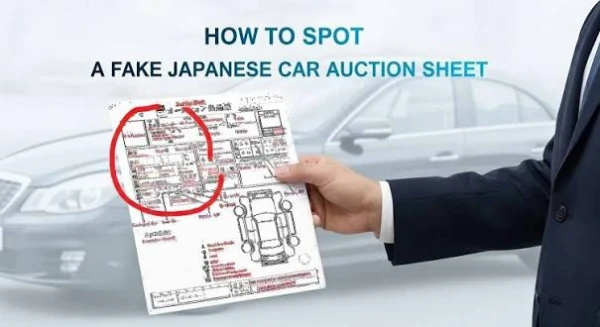
If the car came from Japan, ask the seller for the auction sheet first. Before a car is sold at a Japanese auction, an inspector checks it and writes a report. That report is the closest thing you will get to the car's true history.
Look at the overall grade. Grades like 4, 4.5 and 5 are good. If you see R or RA, the car has had accident repair. The interior grade runs from A (best) to D (poor). The sheet also shows the mileage and small marks drawn on a body sketch: A is a scratch, U is a dent, W is a wavy panel, S is rust.
Two things people forget: check that the chassis number on the sheet matches the number on the car, and ask for the auction name and lot number so you can confirm the sheet is real.
Don't trust the meter blindly
Meter tampering happens, so check the car itself. A car with 30,000 km should not have a shiny, smooth steering wheel or pedals worn flat. Look at the driver seat, the gear knob and the key area too. If the car looks tired and the meter says it is young, something is wrong. Old service stickers and oil change labels in the engine bay or door frame can also help.
Walk around the car in daylight
Never look at a car at night or in a dark garage. Daylight shows everything.
Stand at an angle and look along each panel. If one door has a slightly different shade or shine, it was probably repainted. Check the gaps between the doors, bonnet and boot. They should look even on both sides. Rough, bumpy paint (like orange skin) is another sign of a respray. Look at rubber seals and door edges for paint overspray.
Also check the bolts on the fenders and bonnet hinges. If the paint on them is broken or scratched, someone has opened them before. If you can, bring a paint thickness gauge. High readings mean filler or new paint.
Look under the bonnet
An engine that is too clean can be a warning. Some sellers wash it to hide oil leaks. Look around the valve cover, oil pan and gearbox for fresh oil. Check the metal rails and the radiator support at the front. If they look bent, welded or repainted, the car probably had a front crash.
Pull out the oil dipstick. Very black, thick oil is bad. Milky oil, like coffee with milk, is worse, because it can mean coolant is mixing with the oil. Rusty or oily coolant is also a bad sign.
Check underneath for rust
Cars from snowy places like Hokkaido can have serious salt rust underneath. Look at the floor, suspension parts and exhaust. Be careful if the underbody has fresh black spray, because it is often used to cover rust or repair work. Wavy or welded chassis rails are a red flag.
Smell and feel the inside
Sit in the car and breathe in. A damp or moldy smell can mean flood damage. Lift the floor mats and look for water marks or rust on the seat bolts. Pull the seat belts out all the way and look for dirt lines or stains.
Then press every button. Test the windows, AC, lights, sunroof and screen. When you turn the key, the airbag light should come on and then go off. If it never comes on, someone may have tampered with it.
Look at tyres and glass
All four tyres should be the same brand and wear evenly. Uneven wear can point to alignment or suspension damage. Tyres also have a four-digit date code. For example, 2823 means week 28 of 2023. Check the small brand mark on each window as well. If one window is different, it may have been replaced after an accident.
Take a real test drive
Ask to start the engine cold, since a warm engine can hide problems. Listen for knocking or rattling. Watch the exhaust: blue smoke means oil is burning, and white smoke can mean a coolant problem.
On a straight, empty road, hold the steering lightly. The car should not pull to one side. Brake firmly and feel for shaking or noise. In automatic and CVT cars, the gears should shift smoothly with no jerk or delay. Drive over a few bumps and listen to the suspension.
Use a scanner and get an expert opinion
A simple OBD scanner can show hidden error codes the dashboard does not display. If it is a hybrid, find out the battery health before buying. A new hybrid battery is very expensive. For any car you are serious about, pay a trusted workshop to inspect it. The fee is small compared with a big repair bill later.
Finally, check the papers
Make sure the chassis number matches every document. Confirm the import papers and customs clearance are genuine, and look into the ownership and registration history in your country. If the papers are unclear or missing, don't buy the car, no matter how nice it looks.
One last thing
A good seller will not rush you. If someone won't let you inspect the car, or won't show the auction sheet, walk away. There are plenty of other cars, and a little patience now can save you a lot of money.
Comments 0
Share your thoughts with other readers. Let us keep the discussion respectful.