
- Tassadaq
- Sep 29, 2026
- Buying Guides
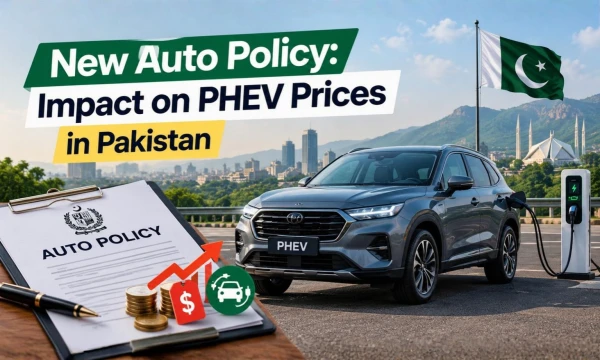
The new Auto Policy 2026-31 is projected to significantly impact Pakistan's electric and hybrid vehicle industry, particularly for Plug-in Hybrid Electric Vehicles (PHEVs), but the effects may not be as simple as a price cut.
PHEVs are between regular gasoline-powered cars and fully electric cars. They are capable of being charged from the outside and powered by electricity for shorter distances, but can also be powered by petrol for longer distances. For instance, BYD's Shark 6 and GWM's Tank 500 PHEV models have introduced this technology into the realms of premium vehicle segments in Pakistan.
The new policy guidance will provide the best incentives for fully electric vehicles and separate PHEVs. According to the recent reports on the approved draft, the government has asked the officials to differentiate between PHEVs and Range Extended Electric Vehicles (REEVs) and Battery Electric Vehicles (BEVs).
Buyers will be impacted by this new policy as it may feature changes for PHEV pricing, will also be influenced by the final tax structure, imported or locally made vehicle, and implementation of the policy.
PHEVs No Longer Get the Same Treatment as BEVs
The most significant one is the distinction between different types of electric vehicles (EVs) that the government has made.
The previous proposals were to classify PHEVs as part of the larger NEV category and gave a lot of tax relief. But the new policy guidance provides the most favorable treatment for BEVs and PHEVs and REEVs are treated differently.
This is important because a PHEV has an internal combustion engine while a BEV is powered by electricity.
The government is thus trying to shift the focus of its incentives away from hybrids and electrics and towards those that provide complete electrification.
Will PHEV Prices Fall Under the New Policy?
One big issue for the Pakistani buyer is that the new Auto Policy will instantly bring down the prices of PHEVs.
The answer is not necessarily.
The policy attempts to lower tariffs and promote new-energy vehicles, but the PHEV pricing will be based on the vehicle's assembly model and import process.
The government also intends to phase out the import duties on cars over the next five years, as opposed to ending all import duties all at once. This implies that gains in price would gradually accrue due to reduced tariffs.
The effect of the imported PHEVs may, thus, differ from the locally assembled PHEVs.
Locally Assembled PHEVs Could Be Better Positioned
In the proposed policy, local assembly is a key issue, as the government is shifting focus from imports to value addition and technology transfer and manufacturing.
For instance, the GWM Tank 500 has been locally manufactured in Pakistan. This also means that it will have a different pricing package than a fully assembled imported car.
The final retail price of CKD kits/component and locally added value will begin to play a more significant role in the final price as tariff reforms are implemented.
The government's overall vehicle policy also aims to drive up local manufacturing and, eventually, tie incentives to export performance.
What About Imported PHEVs?
This may not be the case for imported PHEVs.
When the cars are fully assembled, they are subject to customs and taxes, exchange rates, freight and other import costs. The final showroom price will be determined by the tax regime applicable on importing the vehicle over the next few years even if the government reduce the taxes.
Buyers need to exercise caution when the new policy is projected to cut the prices of all PHEVs by a certain percentage.
The last advantage will differ between different models.
Finance Could Make Expensive PHEVs More Accessible
Further down the line in the proposed auto-policy plan, there is a potential indirect benefit for consumers who purchase PHEVs; higher limits on vehicle financing.
The policy has suggested to increase the maximum financing limit from Rs. 3 million to Rs. Increased to five years the maximum repayment period to 10 million.
That's an important factor for the PHEV market in Pakistan, as most plug-in hybrids offered in the market are in the higher price range, SUV or pickup.
With a higher financing limit, the vehicles would be more accessible to customers who are unable to afford the entire purchase price in one payment.
But buyers will only benefit in practice once the banks have determined their availability for financing and the actual conditions they will provide.
PHEVs vs BEVs Under the New Policy
The direction of the policy makes an important distinction between PHEV and 100% electric cars.
|
Vehicle Type |
Policy Direction |
|
BEV |
Strongest focus for NEV incentives |
|
PHEV |
Treated separately from BEVs |
|
REEV |
Treated separately from BEVs |
|
Conventional ICE |
Subject to conventional vehicle tax structure |
In addition, the government has established more general targets on electric mobility and decreasing reliance on imported petroleum.
This may help to progressively drive the uptake of fully electric vehicles, especially as charging capacity expands and the tax policies are adjusted.
What PHEV Buyers Should Expect
The new policy should be considered a gradual price cut programme, for people who are intending to buy a PHEV in Pakistan.
A lower price may be possible as tariffs will be lowered over time and a greater amount of domestic produce will become available. But just how much those savings will be will depend on the final rules.
Tax rate is not the only thing buyers should think about when looking at the vehicle's fuel economy, electric-only range, charging requirements, battery warranty, maintenance costs and resale value.
It's particularly vital for high-end PHEVs; the up-front cost of these vehicles often is significantly more than that of traditional vehicles.
The Market Is Already Seeing Tax Changes
The policy comes as a result of key changes in hybrid vehicle taxation that will occur in 2026.
As the previous concessions expired, hybrid vehicles were then temporarily placed under the existing 25% sales tax regime. More recently, the Federal Board of Revenue has cut sales tax to 18% for locally manufactured hybrid electric vehicles having engine capacity up to 2000cc as of 13.9.2026.
This is an illustration of the immense speed at which the tax landscape is evolving and the fact that PHEV and hybrid prices can vary even before implementation of the 5-year auto policy.
What This Means for Pakistan’s PHEV Market
The new Auto Policy has the potential to eventually make the market for cars more competitive in Pakistan but PHEVs are not likely to have the same level of support as a pure electric vehicle.
Some relief may be available for locally assembled PHEVs due to lower component costs and increased localization and funding support. Imported models could benefit in the future as tariffs are phased out over time, but they will still be sensitive to exchange rates and import taxation.
Hence, it is essential for buyers who keep an eye on the policy rates in Pakistan to differentiate between announced policy suggestions, what is approved and what has actually implemented.
As the Auto Policy 2026-31 transitions to implementation, SpotMV will keep an eye on these developments.
Conclusion
The new Auto Policy 2026-31 will undoubtedly bring new dynamics in the taxation and support of electrified vehicles in Pakistan. Yet, PHEVs aren't being given the same treatment as BEVs, as the government places more importance on fully electric vehicles.
The policy could be a good thing for PEV owners as it slowly lowers the tariff, provides better financing and boosts local manufacturing. Concurrently, there is no reason to believe that all PHEVs will become cheaper all at once.
The actual effect on prices will be influenced by the specifics of implementation, the degree of assembly, duties and taxes, as well as subsequent policy choices made by the government. For that, buyers should have an eye on the official notifications and should not trust the headline of the expected price reductions of PHEV
Comments 0
Share your thoughts with other readers. Let us keep the discussion respectful.