

- Tassadaq
- Jul 29, 2026
- Buying Guides
If you're an overseas Pakistani thinking about bringing a car home, or a business owner exploring vehicle imports, 2026 is not the year to rely on last year's numbers. The rules changed — significantly — and a calculator is only as good as the assumptions behind it. This guide walks through what actually determines your import tax bill in 2026, why the old "personal baggage" shortcut is gone, and how to work out a realistic total cost before you commit to shipping a car.
What Changed in 2026
For years, the personal baggage scheme was the easiest and by far the most popular way for overseas Pakistanis to bring in a used car — it accounted for roughly 99% of used-vehicle imports under the diaspora schemes. That changed on January 15, 2026, when the Ministry of Commerce issued SRO 61(I)/2026, formally abolishing the personal baggage route for vehicles. The decision followed an Economic Coordination Committee ruling in December 2025 and came under pressure from the IMF, which had flagged the scheme as widely misused — cars were routinely routed through the UAE or other third countries to dodge the spirit of the rules.
That leaves two personal-import routes standing: the Gift Scheme and the Transfer of Residence (TR) Scheme. Both now come with tighter conditions:
- The waiting period between imports by the same person has grown from 700 days to 850 days.
- Under TR, the car must come from the country where you actually live — no more buying in Japan and shipping under a UAE-based residency.
- Vehicles brought in under either scheme now carry a mandatory one-year ban on resale.
Separately — and this trips a lot of people up — the government is also phasing out a 40% regulatory duty that applies to general commercial imports of used cars. That duty started at 40% and is scheduled to fall to 30% in 2026, 20% in 2027, 10% in 2028, and disappear entirely by mid-2029. This is a different track from the Gift/TR changes above, and it applies to commercial imports, not personal ones — but the two reforms get confused constantly, including in some outdated calculator tools still circulating online.
The Three Ways a Car Enters Pakistan
Before any tax figure means anything, you need to know which door you're walking through, because each has its own math.
1. Gift Scheme — A vehicle sent to a Pakistani resident by a relative or associate abroad. Requires the sender to have lived abroad for at least two years, and the vehicle can't be older than three years (for cars) or five years (for other vehicles) at the time of shipment.
2. Transfer of Residence (TR) — For overseas Pakistanis relocating back, or returning after an extended stay. You typically need a minimum stay abroad of around 700 days within a recent window (this figure has been tightened and is worth confirming with FBR before you plan around it), and the vehicle must have been owned for at least a year abroad.
3. Commercial Import — Anyone can import a new vehicle commercially, and used commercial imports are being progressively liberalized as described above. This route pays full percentage-based duty rather than the discounted fixed-dollar rates below, and it's rarely the cheaper option for a single used car.
Students receiving remittances, non-earning dependents, and anyone who has already imported, gifted, or received a vehicle in the past two years are generally not eligible under Gift or TR.
How Duty Is Calculated Under Gift and TR (Fixed-Dollar Method)
Here's the part that makes these two schemes attractive: instead of taxing the car's actual value, FBR applies a fixed US-dollar duty figure based on engine capacity, regardless of what you actually paid for the car. A ten-year-old 1300cc sedan and a nearly-new one pay the same base duty — only the depreciation allowance differs.
| Engine Capacity | Fixed Duty (Approx. USD) |
|---|---|
| Up to 800cc | $4,800 |
| 801cc – 1000cc | $6,000 |
| 1001cc – 1300cc | $13,200 |
| 1301cc – 1500cc | $18,590 |
| 1501cc – 1600cc | $22,550 |
| 1601cc – 1800cc (excluding jeeps) | $27,940 |
On top of this, a depreciation allowance of 1% per month is applied based on the vehicle's age, which reduces the payable amount as the car gets older. Note that some newer calculator tools online quote a lower table (for example, $5,500 for 801–1000cc) and a 2% monthly depreciation figure — these numbers move between FBR notifications, so treat any table, including this one, as a starting estimate rather than a final figure. Confirm the current SRO with a licensed customs clearing agent or FBR directly before you commit money.
A rough working example: a 1300cc Corolla that is three years old would start from the ~$13,200 base duty, then have depreciation applied for its age (subject to the applicable monthly rate and any cap, commonly around 50%), landing the effective payable duty meaningfully below the base figure — plus a flat smart card/registration-related fee that applies to all vehicles.
How Duty Is Calculated for Commercial Imports (Percentage Method)
If you're importing commercially — new vehicles, or used vehicles once liberalization takes full effect — the math looks completely different, and it's driven by the car's actual value (CIF: Cost, Insurance, and Freight), not engine size.
The rough stack looks like this:
- Customs Duty — commonly cited around 70% of CIF value for larger vehicles, though this varies by category.
- Regulatory Duty — an additional layer, currently around 40% for used commercial imports (the rate being phased down toward zero by 2029), with different rates for new vehicles.
- Sales Tax — 17%, applied to the duty-paid value (CIF plus the duties above).
- Advance Income Tax — around 3% for a registered/filer importer, higher for non-filers.
- Port charges, clearance fees, and a smart card/registration fee.
Worked out on paper, a car with a $15,000 CIF value could see customs duty of around $10,500, regulatory duty around $6,000, sales tax on the duty-paid value adding roughly $5,355, and advance income tax adding close to $945 — before port and clearance fees. That's a rough illustration, not a quote, and actual rates depend on vehicle category and the SRO in force at the time of import.
Hybrid and Electric Vehicle Concessions — Proceed With Caution
FBR's general guidance has long listed a 50% duty exemption for hybrid vehicles up to 1800cc and a 25% exemption for hybrids between 1800cc and 2500cc, alongside stronger incentives for pure EVs. However, at least one industry report indicates this hybrid concession may have been withdrawn or altered through a separate notification, while FBR's own published page had not been updated to reflect that at the time of writing. If a hybrid or EV import is part of your plan, don't take the concession for granted — get written confirmation from customs or a clearing agent before you factor a discount into your budget.
Building Your Own Estimate: The Formula
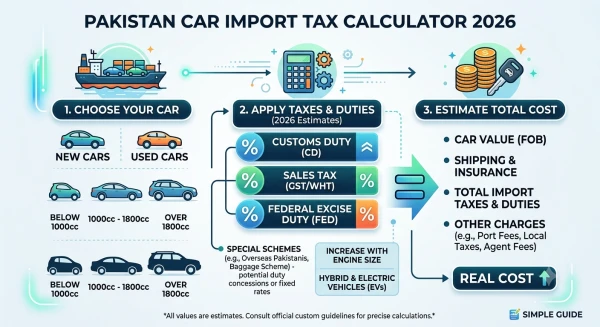
Whether you're doing this by hand or plugging numbers into a spreadsheet, the calculation follows a consistent shape:
For Gift/TR imports: Fixed duty (by cc) − depreciation allowance (based on age) + smart card fee = amount payable
For commercial imports: Total Landed Cost = CIF Value + Customs Duty + Regulatory Duty + Sales Tax + Advance Income Tax + Port Charges + Clearance Fees
In both cases, the inputs that actually move the number are: engine capacity, vehicle age, import scheme, filer/non-filer status, and whichever SRO is currently in force. Everything else is arithmetic.
A Few Things Worth Double-Checking Before You Commit
- Age limits keep shifting. Some reporting points to a full removal of the age limit for commercial imports from July 2026, while personal Gift/TR imports remain capped at three years for cars. Don't assume last year's age rule still applies.
- "Calculator" websites vary in accuracy. Several online tools reference different duty tables and depreciation rates, sometimes years out of date. Cross-check any number against FBR's official vehicle-import page or a licensed clearing agent before wiring money.
- The one-year resale ban is new and strictly enforced for Gift and TR imports — factor that into your planning if you were counting on reselling quickly.
- Under-declaring the vehicle's value is not a shortcut. Customs cross-checks declared values against international valuation databases, and penalties can include fines or seizure.
The Bottom Line
Pakistan's car import tax structure in 2026 is genuinely two different systems wearing one name: a fixed-dollar, engine-size-based structure for personal Gift and Transfer of Residence imports, and a value-based, multi-layered duty stack for commercial imports that's being gradually liberalized through 2029. The personal baggage scheme that used to make this simple is gone. If you're estimating costs, start by figuring out which scheme you actually qualify for — that decision matters more than any tax rate, because it determines which formula you're even using.
When in doubt, treat any number from an online calculator as a planning estimate, not a quote, and confirm the live figures with FBR or a customs clearing agent before you ship.
Comments 0
Share your thoughts with other readers. Let us keep the discussion respectful.