

- Tassadaq
- Aug 24, 2026
- Buying Guides
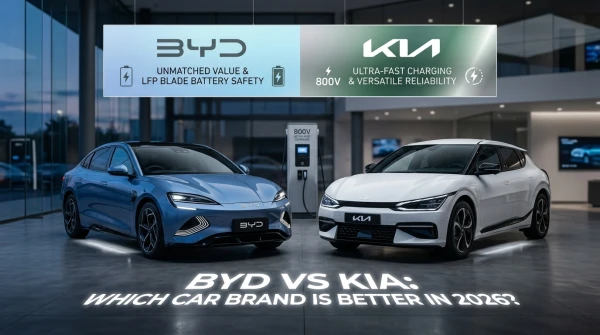
The global automotive landscape has shifted dramatically, with the battle for EV dominance taking center stage. Choosing between BYD and Kia comes down to your driving needs: whether you prioritize unbeatable entry-level EV value and advanced battery safety or legacy brand reliability, ultra-fast charging, and versatile powertrain options.
BYD (Build Your Dreams) continues to dominate market volume through aggressive pricing and vertical integration, while Kia maintains a strong foothold with its award-winning E-GMP platform and well-established dealer network.
1. Overview of Both Brands
BYD (Build Your Dreams)
- Market Position: Global leader in New Energy Vehicles (NEVs), manufacturing both pure electric vehicles (BEVs) and plug-in hybrids (PHEVs).
- Core Advantage: Complete vertical integration—BYD manufactures its own batteries, microchips, and electric motors in-house, significantly lowering production costs.
- Key Models: BYD Dolphin, Atto 3, Seal, Sealion 7, and Shark 6 PHEV ute.
Kia
-
Market Position: A top-tier global automaker offering petrol, hybrid, plug-in hybrid, and dedicated electric vehicles.
-
Core Advantage: Established global service network, high build quality, intuitive vehicle design, and market-leading long-term warranty coverage.
-
Key Models: Kia EV3, EV5, EV6, EV9, Sportage, and Sorento.
2. Key Differences Breakdown
Battery Technology & Charging Capabilities
-
BYD’s Blade Battery: Utilizes Lithium Iron Phosphate (LFP) chemistry integrated directly into the chassis (Cell-to-Body technology). It offers superior thermal stability, higher crash safety, and longer cycle life without relying on nickel or cobalt. Peak DC charging typically ranges between 115 kW and 150 kW.
-
Kia’s E-GMP 800V Architecture: Dedicated EVs like the Kia EV6 and EV9 utilize an 800-volt charging system. This enables ultra-fast DC charging speeds of up to 235 kW–350 kW, allowing a 10% to 80% recharge in under 18 minutes on compatible fast chargers.
Vehicle Performance and Range
-
Range: Both brands deliver competitive real-world range figures ranging from 400 km to 600 km (WLTP) depending on battery size and drivetrain variant.
-
Driving Dynamics: Kia tunes its suspensions specifically for Western market driving preferences, offering sharper handling and road feedback. BYD focuses heavily on ride comfort and supple suspension tuning ideal for urban commutes.
Interior Tech and User Experience
-
BYD Interior: High-tech, minimalist aesthetic featuring signature 15.6-inch rotating central touchscreen displays, built-in karaoke functions, ambient lighting, and comprehensive over-the-air (OTA) software updates.
-
Kia Interior: Premium dual-curved digital displays paired with physical tactile buttons for critical HVAC and audio functions. Offers native Apple CarPlay and Android Auto alongside robust connected-car services.
3. Head-to-Head Comparison
|
Feature / Metric |
BYD |
Kia |
|
Powertrains Offered |
Pure Electric (BEV) & PHEV only |
Petrol, Mild Hybrid, PHEV, & BEV |
|
Battery Tech |
In-house LFP Blade Battery (CTB) |
LFP & NMC options (E-GMP Platform) |
|
Peak DC Charging |
Up to 150 kW |
Up to 350 kW (800V models) |
|
Pricing Strategy |
High Value / Lower Entry Cost |
Mid-Tier / Premium Pricing |
|
Vehicle Warranty |
6 Years / 150,000 km (8 Years Battery) |
7 to 10 Years (Region dependent) |
|
Service Network |
Rapidly expanding dealer network |
Well-established global dealer presence |
4. 5-Year Total Cost of Ownership (TCO) Analysis
When calculating the true cost of owning a car over 5 years (assuming 15,000 km per year / 75,000 km total), the initial purchase price is only part of the equation. Below is a realistic financial projection comparing mid-sized EV models from both brands (e.g., BYD Seal / Atto 3 vs. Kia EV6 / EV5).
5-Year Cost Breakdown Projection (USD Estimates)
|
Expense Category |
BYD (Mid-size EV) |
Kia (Mid-size EV) |
Winner / Advantage |
|
Purchase Price (MSRP) |
~$38,000 |
~$48,000 |
BYD (Saves ~$10,000 upfront) |
|
Depreciation (5 Years) |
~$19,000 (~50% loss) |
~$21,600 (~45% loss) |
Kia (Slightly better value retention) |
|
Maintenance & Servicing |
~$1,200 (Capped-price) |
~$1,500 |
BYD (Lower scheduled service costs) |
|
Energy / Charging Costs |
~$2,800 (Home + Public) |
~$2,900 |
Tie (Similar efficiency ratings) |
|
Insurance (5 Years) |
~$7,500 |
~$6,800 |
Kia (Cheaper to insure due to parts network) |
|
Total 5-Year Out-of-Pocket Cost |
~$30,500 |
~$32,800 |
BYD |
Key Cost Considerations:
-
Upfront Capital Savings: BYD's aggressive pricing gives you an immediate financial cushion of $5,000 to $10,000. This offsets its slightly higher initial depreciation percentage.
-
Insurance Rates: BYD vehicles can attract slightly higher insurance premiums in certain Western markets due to less mature localized parts distribution channels, whereas Kia benefits from a long-established supply network.
-
Servicing & Warranty Coverage: Pure EV models from both brands save significant money on brake wear and engine oil changes. However, Kia’s longer transferrable warranty gives it a distinct advantage when selling the vehicle on the second-hand market after 5 years.
5. Final Verdict: Which Brand Should You Buy?
Choose BYD If:
-
You want maximum features and range for the lowest overall 5-year outlay.
-
You value cutting-edge battery safety with BYD’s structural Blade LFP tech.
-
You are primarily driving in urban or suburban environments where standard 100 kW–150 kW fast charging is sufficient.
Choose Kia If:
-
You frequently travel long distances and need ultra-fast 800V charging capabilities.
-
You prefer a balanced interior design with physical controls alongside screens.
-
You prioritize the peace of mind offered by an established dealer network and stronger secondary market resale value.
-
You require a traditional petrol or hybrid engine option rather than a full electric drive.
Comments