

- Tassadaq
- Oct 03, 2026
- Buying Guides
Tire pressure is one of those things most drivers know they should check, but the numbers can become confusing when a car, tire gauge and air pump use different units.
You might see 32 PSI on one pressure gauge, 220 kPa on another, or a vehicle information label showing 2.2 bar. They are different units for measuring the same thing, but knowing how to convert between them makes it much easier to set your tires correctly.
This guide explains PSI, kPa and bar, shows common tire pressure conversions, and explains how to find and check the recommended pressure for your car.
Tire Pressure Units Explained: PSI, kPa and Bar
Three units commonly appear when dealing with car tire pressure:
- PSI — pounds per square inch
- kPa — kilopascals
- bar — a metric unit of pressure
The pressure itself does not change when you convert between these units. Only the way the pressure is expressed changes.
For example, approximately:
32 PSI = 220.6 kPa = 2.21 bar
So if your vehicle recommends 32 PSI and the air machine asks you to enter kPa, you would use approximately 221 kPa.
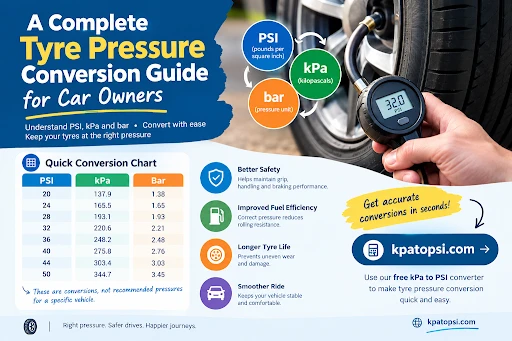
Tire Pressure Conversion Chart
The following chart gives some common tire pressure conversions.
|
PSI |
kPa |
Bar |
|
20 |
137.9 |
1.38 |
|
22 |
151.7 |
1.52 |
|
24 |
165.5 |
1.65 |
|
26 |
179.3 |
1.79 |
|
28 |
193.1 |
1.93 |
|
30 |
206.8 |
2.07 |
|
32 |
220.6 |
2.21 |
|
34 |
234.4 |
2.34 |
|
36 |
248.2 |
2.48 |
|
38 |
262.0 |
2.62 |
|
40 |
275.8 |
2.76 |
These are mathematical conversions, not recommended pressures for particular vehicles.
If you need a specific conversion, you can use the kPa to PSI conversion tool to convert the value directly.
How to Convert PSI to kPa
To convert PSI to kPa, multiply the PSI value by approximately 6.89476.
PSI to kPa formula
kPa = PSI × 6.89476
For example, if your tire pressure is 32 PSI:
32 × 6.89476 = 220.63 kPa
So:
32 PSI ≈ 220.6 kPa
For everyday tire-pressure measurements, rounding to the nearest whole kPa is usually convenient:
32 PSI ≈ 221 kPa
How to Convert kPa to PSI
To convert kPa to PSI, divide the kPa value by approximately 6.89476.
kPa to PSI formula
PSI = kPa ÷ 6.89476
For example, suppose your gauge shows 250 kPa:
250 ÷ 6.89476 = 36.26 PSI
Therefore:
250 kPa ≈ 36.3 PSI
If you frequently need to convert kPa to PSI, an online converter can save you from calculating each value manually.
How to Convert Bar to PSI and kPa
Bar is also easy to convert.
Bar to kPa
1 bar = 100 kPa
Therefore:
-
2.0 bar = 200 kPa
-
2.2 bar = 220 kPa
-
2.4 bar = 240 kPa
-
2.5 bar = 250 kPa
-
2.8 bar = 280 kPa
-
3.0 bar = 300 kPa
Bar to PSI
1 bar ≈ 14.5038 PSI
For example:
2.2 × 14.5038 = 31.91 PSI
So:
2.2 bar ≈ 31.9 PSI
A useful quick-reference conversion is:
2.0 bar ≈ 29.0 PSI
2.2 bar ≈ 31.9 PSI
2.4 bar ≈ 34.8 PSI
2.5 bar ≈ 36.3 PSI
2.8 bar ≈ 40.6 PSI
3.0 bar ≈ 43.5 PSI
How to Find the Correct Tire Pressure for Your Car
A conversion chart tells you what a pressure value means. It does not tell you what pressure your particular car should have.
Your vehicle manufacturer's recommended pressure can usually be found in one or more of these places:
-
The owner's handbook
-
A placard on the driver's door or door frame
-
Inside the fuel-filler flap
-
Vehicle documentation
-
Information supplied by the manufacturer
You may also find separate recommendations for the front and rear tires.
Some vehicles provide different pressures depending on whether the vehicle is lightly loaded or carrying several passengers and luggage. Always follow the manufacturer's instructions for the particular load condition.
Don't use the number printed on the tire sidewall as your normal pressure
The number shown on a tire's sidewall is not necessarily the recommended pressure for your vehicle.
The tire manufacturer and vehicle manufacturer provide different pieces of information. For everyday inflation, use the vehicle manufacturer's recommended pressure.
When Should You Check Your Tire Pressure?
A good routine is to check your tire pressures regularly and before longer journeys.
It's also sensible to check them when:
-
You've noticed a tire looks low
-
The vehicle has been carrying a different load
-
You're preparing for a long journey
-
You've recently had a tire repaired or replaced
-
A tire-pressure warning appears on the dashboard
A TPMS warning should not be ignored simply because the tire doesn't look flat. The system can alert you to a pressure loss that isn't obvious visually.
Tire Pressure Conversion: Common Questions
How many kPa is 32 PSI?
32 PSI is approximately 220.6 kPa, or about 221 kPa when rounded to the nearest whole number.
How many PSI is 250 kPa?
250 kPa is approximately 36.3 PSI.
How many PSI is 2.5 bar?
2.5 bar is approximately 36.3 PSI.
How many kPa is 35 PSI?
35 PSI is approximately 241.3 kPa.
Is PSI the same as kPa?
No. PSI and kPa are different units used to express pressure. They measure the same physical quantity but use different scales.
Which tire pressure unit should I use?
Use whichever unit your vehicle, pressure gauge or air machine requires. The important thing is to enter the correct equivalent pressure.
For example, if your vehicle recommends 32 PSI and your air machine uses kPa, approximately 221 kPa represents the same pressure.
Should I use the tire's maximum PSI?
Not unless that is also the pressure specified by your vehicle manufacturer for the particular situation.
The recommended inflation pressure for your car should come from the vehicle manufacturer rather than simply using the maximum pressure printed on the tire.
Final Thoughts
Understanding tire pressure conversion is mainly about making different units easier to work with. PSI, kPa and bar describe pressure in different ways, so a conversion lets you compare the numbers without changing the actual pressure.
The most useful conversions to remember are:
1 PSI ≈ 6.895 kPa
1 bar = 100 kPa
1 bar ≈ 14.504 PSI
But the conversion itself is only part of the job. The more important number is the recommended pressure for your specific vehicle.
Check the manufacturer's information, measure your tires when they are cold, and use a reliable pressure gauge. If your gauge or air pump uses a different unit, simply convert the recommended value rather than guessing.
Comments 0
Share your thoughts with other readers. Let us keep the discussion respectful.