

- Tassadaq
- Nov 12, 2026
- Buying Guides
One of the most frequently asked questions when purchasing a car in Pakistan is whether to opt for a Japanese imported car or a locally built car. Each option comes with its own set of pros and cons, and the choice would depend on your budget, driving requirement, maintenance preference and expectation.
Japanese imported cars are well known for their fuel efficiency, comfort and advanced features, and build quality. However, locally produced cars are sometimes preferred owing to the ease in having spares available and the convenience of maintenance, as well as the ease of resale.
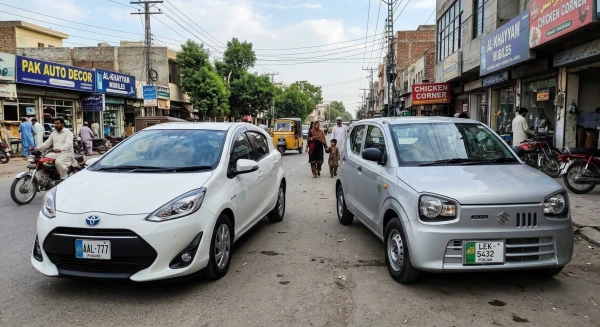
A buyer interested in a Japanese Toyota Aqua or Honda Vezel can also consider a locally assembled Toyota Yaris or Honda City. These cars may be of different types, but they provide an idea of the options in Pakistan.
So, what's better? Let's look at the Japanese imported cars and the local cars in detail.
Japanese Imported Cars vs Local Cars: Understanding the Difference
A good understanding of the differences between these two categories is necessary before comparing the features.
Japanese imported cars are those which are produced for the Japanese market and then imported in Pakistan. There are many secondhand cars which have been driven in Japan. Popular examples include:
-
Toyota Aqua
-
Toyota Vitz
-
Toyota Prius
-
Honda Fit
-
Honda Vezel
-
Suzuki Hustler
-
Daihatsu Mira
-
Nissan Dayz
These vehicles may even have some features that are tailored to Japanese preferences such as superior safety equipment, climate control, hybrid systems and fuel efficiency.
Locally assembled cars are those cars which are manufactured or assembled by local manufacturers. Examples of these include:
-
Suzuki Alto
-
Suzuki Swift
-
Toyota Yaris
-
Honda City
-
Honda Civic
-
Toyota Corolla
-
Hyundai Tucson
The vehicle generally caters the needs of the Pakistani market and the local road conditions, the availability of fuel and maintenance of the vehicles.
It is important to keep in mind that not all Japanese imported cars are superior to all local cars. As much as its origin, the model, manufacturing year, condition and maintenance history are important.
Price Comparison: Which One Is More Affordable?
The most important criterion for buyers is the price.
Japanese imports may provide more features and equipment in a specific price range. But, prices will vary based on the import duty, exchange rate, availability, condition and market demand.
The features that a nicely maintained Japanese imported hatchback can provide may not be present in a similarly-priced car made in the country.
Other cars are built locally and can be purchased from trusted car dealerships, and may have various options and financial terms. Purchasers can also opt for the new car without being concerned of the previous ownership or any hidden accident history.
But it's not the same for local cars. There are some models that have to be purchased locally that cost high and some Japanese used imports might provide better equipment at the same price.
Which is better?
Japanese imports might be a better option if you're looking for more features for your money. If you're looking for a brand new car that's been built locally, has a clear purchase history and manufacturer's warranty, then you may want to consider a locally assembled car.
Build Quality and Reliability
One of the reasons for the popularity of Japanese imported cars is their build quality.
Japanese manufacturers are well known for manufacturing durable vehicles. There's a lot of good interior finishing, comfortable seats, well designed cabins and solid construction in many Japanese imports.
But, the condition of used imported cars is very significant. What might appear to be a clean car on the outside may have been in an accident, had been fixed previously, have mechanical issues, or may not have been well maintained.
The performance of locally assembled cars is also reliable, especially if properly maintained as per the manufacturer's guidelines. The best thing about them is that the buyers can get a brand new car straight from the authorized dealership.
This will help minimize the risk of ownership history.
Which is better?
A well-kept, imported Japanese car can be a very good car. But with a brand new local car, it gives more assurance of who owns the vehicle and how it was maintained.
The “best” depends on the vehicle that's being considered, not just its import or local manufacture.
Fuel Average: Japanese Imports or Local Cars?
In Pakistan, fuel efficiency is especially crucial due to the high cost of petrol, as it can be an integral expense for car owners.
Fuel economy is popular with Japanese imported cars, particularly the smaller hatchbacks and hybrid models.
For example:
-
Toyota Aqua is known for its hybrid fuel efficiency.
-
Toyota Prius' hybrid technology is engineered for better fuel efficiency.
-
Honda Fit comes in fuel-saving petrol and hybrid variants.
-
The Daihatsu Mira is a popular city car because of its small size and economical design.
There's also good fuel economy for locally assembled vehicles, depending on the engine size and technology of the car.
The Suzuki Alto is made for cheap daily driving, the Toyota Yaris and Honda City is a compromise between performance and fuel consumption.
The actual fuel average can be affected by:
-
Engine condition
-
Driving style
-
Traffic conditions
-
Tyre pressure
-
Air conditioning usage
-
Vehicle maintenance
-
Road conditions
Hybrids can achieve greater fuel efficiency in stop and start traffic but be sure to check the battery and hybrid system before buying.
Which is better?
For frequent travellers who are looking to cut down on fuel costs, Japanese hybrid cars may be a good option. If you prefer a simple and cost-effective car that you can assemble locally, but do not need the added complexity of an older hybrid system, a locally assembled small car should be more feasible.
5. Features and Technology
The features of Japanese imported cars are often a point of interest.
Even the smallest Japanese cars might be equipped with:
-
Push-button start
-
Automatic climate control
-
Smart key entry
-
Cruise control
-
Rear-view camera
-
Parking sensors
-
Advanced infotainment systems
-
Multiple airbags
-
Selected lane assistance in selected models.
These features are dependent on the model and variant.
Locally-built cars have also made major strides of improvement. Some new models have convenience systems such as touch panel infotainment systems, rear cameras, and automatic climate control along with airbags and ABS.
But there are differences in the amount of equipment available for safety and comfort between variants. It is always important to compare actual specifications, and not to assume that all versions are the same.
Which is better?
In higher-grade models, Japanese imports might be able to deliver more features at a lower cost. Local vehicles, however, can offer the same benefit of modern equipment, and an all-new vehicle and manufacturer's support.
Maintenance and Spare Parts Availability
Maintenance is one of the most significant characteristics which distinguish Japanese imported cars from local assembled cars.
Frequently, locally assembled vehicles will have an edge as spare parts can be found easily throughout the country. Mechanics also know popular cars like the Suzuki Alto and the Toyota Corolla, the Honda City and the Suzuki Swift.
This makes it easy to undertake routine maintenance.
Japanese imports may be a bit more difficult to service, especially if they aren't as popular in this country. Some are likely to be obtained from specialty stores or overseas.
Hybrid vehicles may require special skills as the battery pack, the electronics and special parts must be diagnosed appropriately.
But some popular Japanese cars like the Toyota Aqua, Toyota Vitz and Honda Fit have created parts and repair networks in major Japanese cities.
When buying an imported car, it is wise to find out what parts are available and how much they cost for the vehicle.
Which is better?
The cars assembled locally often are more convenient to maintain and have easier access to parts. Additionally, Japanese imports can be kept easily with the popular model with good parts support.
Resale Value in Pakistan
Resale value is important because most people will end up reselling their car and moving to the next one.
Certain categories of imported cars are in good demand from Japan. Hatchbacks that are fuel-efficient, hybrid vehicles and popular Japanese models are frequently on the market for used cars.
The condition, mileage, model year, auction history and demand or lack of it in the vehicle are all important factors in resale, however.
The locally built cars also have a well developed resale market. Popular models like Toyota Corolla, Honda City and Suzuki Alto are easily recognized and are more easily available for sale in many regions of Pakistan.
New vehicles also appeal to people who want to be sure they are brand new and that local maintenance services are available.
Which is better?
Both can be good resale options. Local models can sometimes have an edge as they are more popular on the market and some Japanese imports are better performing because they are more fuel efficient and include features.
Even if you are buying a car imported from overseas, always take into account the resale value of the car before you buy.
Safety Features and Driving Comfort
Never cut corners when it comes to safety.
Depending on the model and grade of Japanese imported vehicles, they may provide more high-tech safety features. Some even have several airbags, ABS, electronic stability control, collision warning and driver assistance systems.
But it's important to note that there may be safety features that are not actual. A higher-grade model of Japanese may include items that lower-grade models do not.
Another benefit of LAVs is the safety features that are engineered locally, which can vary from variant to variant. Lower-end models may not have as many safety features as higher end models.
Another way in which Japanese imports may be appealing is in the comfort of the driving experience. There are many that provide comfortable seats, good suspension, and well-designed interior.
There are suitable comforts for Pakistani roads in the local vehicles too, but they differ by the model.
Ground clearance is an important factor. Some Japanese cars were made for smooth roads in Japan, and these may have a lower ground clearance than is preferred by consumers by rough streets, speed breakers and uneven roads in Pakistan.
Which is better?
In some areas, Japanese imports may have more sophisticated features and interior. Local vehicles may be more suitable for everyday driving, though, depending on the ground clearance, suspension and design.
Warranty and After-Sales Support
One of the benefits of purchasing a brand new car that was assembled locally, is that you can get manufacturer warranties and the support of the manufacturer's dealerships.
Buyers may be able to obtain warranty for a particular part and system, depending on the manufacturer and model. They can also go to the workshops for maintenance and repair, which are authorized.
As a rule, used Japanese imported cars in Pakistan do not have the same manufacturer's warranty and support. They might have trouble getting to their past service records, too.
There are some dealers that provide their own term limited warranties; however, buyers will want to read the terms and conditions before taking the dealers word for it.
This distinction can come to be particularly significant when buying into a hybrid. Major component failure or fault in the battery can be expensive to repair.
Which is better?
Locally built cars benefit from having most of their car warranty along with authorised after sales support. Japanese vehicles might need a little more attention to detail and an independent mechanic.
Import Rules and Documentation in Pakistan
There's a little extra paperwork involved when purchasing a Japanese imported car.
The vehicle must be properly imported into the country and must have proper customs documentation, chassis and engine numbers, etc. must all match. In addition to checking that the car can be registered in their name, the buyer should also ensure that the registration documents can be transferred to their name.
The policy for the import of vehicles in Pakistan was adjusted in January 2026. The government abanded the Personal Baggage Scheme for used vehicle imports, but kept the Gift and Transfer of Residence schemes, albeit with slightly different terms and conditions. All vehicles brought in under these schemes also have a 1 year restriction on transfer of ownership.
It is particularly important to check the import route and whether the vehicle is legally transferred before buying an import vehicle due to these rules.
Another important factor in an assembled car is to verify the registration documents, invoice, number plates and ownership record which should be checked by the buyers. When buying a used vehicle make sure to check the vehicle's registration with the relevant Excise and Taxation authority.
Which is better?
Purchasing a locally assembled vehicle typically is easier and less tedious than buying a vehicle that was assembled in another country. It is also safe to import Japanese items, but it is advisable to check on the import history and legal status of the items.
Common Problems to Check Before Buying a Japanese Imported Car
While there are some benefits to Japanese imported cars, not all cars on the market in Pakistan are top-notch.
There may be some accidents in some used imports which might have been fixed before shipping them or had been driven a lot of time before they were imported into Pakistan.
Below are a couple of things you should look for:
-
Checking auction sheet (If imported by auction): Check auction sheet and match chassis number. Don't use just a copy or a shared copy.
-
Verify mileage: Check with the auction records, the interior of the vehicle and the service history.
-
Accident history; Check for major repairs on the chassis, pillars, doors, bonnet, boot floor and any areas of the structure.
-
Engine and transmission: Listen for anything out of the ordinary, check for any leaks, smoke, jerks or delayed gear changes.
-
Hybrid battery: Check battery and hybrid system in hybrid vehicles by means of appropriate diagnostic equipment.
-
Documents: Ensure that there are valid registration and import papers and that the vehicle may be transferred.
These checks are significant since a low buy could not necessarily signify a great deal.
What Should You Choose According to Your Needs?
There is no one right answer for all buyers. You'll have to consider it according to your usage.
|
Buyer requirement |
Better option to consider |
|
Better fuel economy |
Japanese hybrid or economical import |
|
Easier maintenance |
Locally assembled car |
|
Manufacturer warranty |
Brand-new local car |
|
More features in a used-car budget |
Japanese import |
|
Widely available spare parts |
Popular local model |
|
Brand-new vehicle |
Locally assembled car |
|
Compact city driving |
Either, depending on the model |
|
Established resale market |
Popular local or Japanese model |
Unless you drive around the city a lot, and you need a car that will get you from point A to point B without spending as much at the pump, then maybe you should consider a well-maintained Japanese import.
When you're looking for a new car with warranty, simple maintenance and easy purchasing, then a locally assembled car may be better.
How SpotMV Can Help You Choose the Right Car
It is crucial to inspect the car before getting on the road whether it is Japanese imported or a locally constructed car.
SpotMV verified car showrooms and dealerships enable buyers to explore cars. Buyers are not just having to take it on faith from pictures and seller descriptions; they can obtain more information prior to making a decision.
Professional inspection may be helpful in the case of used cars and can help them identify any apparent damage, mechanical concerns, and signs of past repairs and other problems that may impact the condition of the used vehicle.
In the case of Japanese imports, it is also critical to examine the auction sheet, chassis number, mileage and import paperwork.
SpotMV's inspection creates a comprehensive video report, detailing the vehicle's condition and identifying areas in need of attention. Purchasers will be able to read the results and ask questions before making a purchase decision.
The idea here is to give your potential buyer the best information and to make the transaction as risk-free as you can.
Conclusion
Both Japanese imported and locally assembled cars have their own niche in Pakistan's automotive market.
Japanese imports are desirable due to their fuel economy, options, comfortable interiors and features. But their condition, maintenance history, documentation and availability of spare parts must be taken into consideration.
It is easier to maintain locally assembled cars, they have better access to authorised workshops, can be resold in a local market and have better warranty support on new cars.
The final choice is that the car that has all the requirements and fits into your budget and is in the best condition. Avoid making just the country of manufacture a deciding factor. An investment in a well-kept vehicle with clear documentation beats a car that looks nice on the outside, but has a shady past.
Frequently Asked Questions (FAQs)
Is it better to buy Japanese cars than local cars in Pakistan?
Japanese imported cars can deliver more fuel-efficient performance, provide more features and comfortable interiors. Local vehicles often offer better maintenance, availability of spare parts and warranty services. Depending on the model and condition, the better choice is decided.
Which is better, Japanese or local in terms of fuel economy in Pakistan?
The Toyota Aqua is a Japanese hybrid vehicle, and is known as one of the most fuel efficient vehicles.Toyota Prius is another Japanese hybrid, and is one of the most fuel efficient. But Japanese small cars like the Suzuki Alto, which are locally built, can also be economical to run on the day to day.
Do Japanese imported cars have a high service cost?
The cost of maintenance varies according to the type of vehicle and the availability of parts. Commonly imported Japanese models tend to be easier to maintain than uncommon ones, but some special parts might be costly.
Is Japanese imported cars more value for money compared to its resale value?
Popular hybrid hatchbacks have a high resale value, and some Japanese imports command high re-sale prices. Resale however is dependent upon the condition, mileage, documentation, model year and market demand.
Is the Japanese imported car deal in Pakistan safe?
Yes as long as you check its auction sheet, mileage, accident history and import documents and mechanical condition. It is recommended to have a professional inspection before payment.
Do local cars have a longer lifespan than imported Japanese cars?
When it comes to new cars, the one built locally has an advantage because it is known who owned it, used it, and maintained it. If you do not want to purchase the vehicle, a well-kept Japanese import is also a good option. It is more important that the vehicle is in good condition rather than what it is made from or its origin.
For urban driving in Pakistan, what is preferable?
Both are acceptable. The Japanese hatchbacks and hybrids are popular in the cities for their small size and fuel efficiency. Local small cars are also convenient since they are easily available for parts and maintenance services.
What are some of the things that I need to look at before purchasing Japanese imported cars?
Verify the auction sheet, chassis number, mileage, engine, transmission, suspension, history, hybrid battery (if one) and import documents and registration status.
Is it possible to import a Japanese car in my name in Pakistan?
As a rule, once a vehicle has been imported and registered, it can be transferred under the following conditions. Vehicles obtained through the Gift and Transfer of Residence schemes, however, will have a 1-year restriction on transfer, from the date of import. Never buy an illegally parked vehicle.
Should I go for buying a Japanese imported car or a new local car?
If you are looking for a specific feature, fuel efficiency, or a model that may not be manufactured in Japan, select a Japanese import, and be able to verify its condition. If you want to have a more convenient maintenance process and easier ownership, you might want to consider a new local car that offers a warranty.
Comments 0
Share your thoughts with other readers. Let us keep the discussion respectful.