
- Tassadaq
- Nov 13, 2026
- News
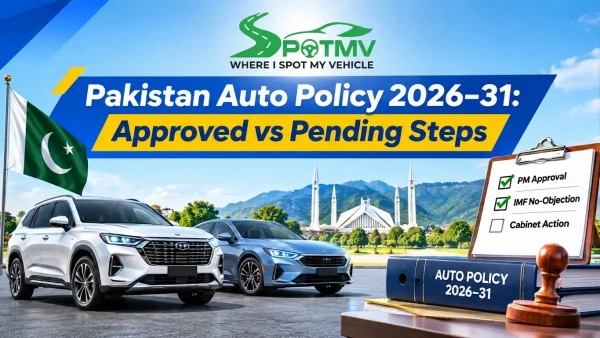
Pakistan’s automobile industry is entering an important phase with the introduction of the New Auto Policy 2026–2031. The government has unveiled a five-year strategy to reduce vehicle prices, promote EVs, boost local production, and increase car exports.
The Pakistani automotive industry has been plagued by various issues for years, such as rising vehicle costs, low local production levels, reliance on imported components, volatile production, and a lack of competitiveness in some segments. To overcome these issues, the new policy will involve the implementation of lower tariffs, localization norms, export incentives and better vehicle safety norms.
The policy also includes provisions to protect car buyers' interests, such as limiting advance payments at the time of booking. Meanwhile, it puts more pressure on car makers to ramp up domestic manufacturing and exports.
But what's changed, and how will those changes impact the typical car buyer?
Let's delve into the Auto Policy 2026-2031 and how it might impact Pakistan's automotive industry.
What Is Pakistan’s New Auto Policy 2026–2031?
The Auto and Auto Parts Manufacturing Policy 2026-2031 is a long-term (five years) government policy aimed at making the Automotive Sector more competitive, locally integrated and export-oriented.
The government is looking to cut its reliance on foreign components and kits to build cars. Rather, the emphasis is on boosting local production, building local suppliers, enhancing technology and vehicles and components that have global competitiveness.
The final draft was approved by Prime Minister Shehbaz Sharif before going on to the formal approval and implementation process. The policy was announced by the Adviser to the Prime Minister on Industries and Production Haroon Akhtar Khan and Information Minister Attaullah Tarar in November 2026.
The overarching aims are:
-
Making vehicles more affordable for the Pakistani buyers.
-
Promote growth of local manufacturing and value addition.
-
Encouraging EVs (electric vehicles) and new energy vehicles.
-
Enhancing the safety of vehicles.
-
Increasing exports of cars and auto parts.
-
Promoting competition and transparency.
-
Ensuring that consumers are not treated unfairly in their bookings.
-
Promoting local manufacturing of car components.
The policy has been designed to target exports of around USD 6 billion over the next 5 years (from 2026 to 2031). It also seeks to create approximately $17.7 billion worth of foreign exchange savings by increasing localisation and domestic production.
Government Aims to Make Cars More Affordable
Lower auto prices are among the top hopes of the new policy.
Over the years, the price of cars in Pakistan has gone up drastically owing to the fluctuation in currency, import tax, taxes, production cost and other economic reasons. This has proven to be a problem for middle-class buyers who want to buy a small passenger car.
The government is to phase out customs duty on completely built-up (CBU) vehicles, completely knocked-down (CKD) kits, and imported automobile parts during the five-year period of the policy.
A CBU car is imported as a complete car, whereas a CKD car is assembled in the country from imported parts and components.
Reduced duties on raw materials and intermediate goods are also likely to lead to lower manufacturing costs for local assemblers.
The government was hoping that these would spur competition and make vehicles more competitive.
But it is important that buyers know that the lower duties do not necessarily mean that showroom prices will decrease immediately. Other factors such as the exchange rate, taxes, manufacturing costs, market conditions and company pricing decisions will also be a factor in determining the final price.
What does this mean for buyers?
With the policy in place properly, auto customers may be able to enjoy more competitive prices and increased choice of vehicles in the next five years. The true effects will be seen when the tariff changes are implemented, however.
Electric Vehicles to Receive More Incentives
In Pakistan's new auto policy, EVs are among the foremost priorities.
The government is keen to boost EV uptake to cut fuel imports, transport emissions and promote a local EV manufacturing industry.
There is already a separate New Energy Vehicle Policy for Pakistan, 2025-2030. The new auto policy will help pave the road to the transition via tax incentives, manufacturing opportunities, and enhancements to the charging infrastructure.
At the policy announcement on November 7, the government announced the following proposed sales tax rates:
|
Vehicle category |
Announced proposed sales tax |
|
Battery Electric Vehicles (BEVs) |
1% |
|
Range-Extended Electric Vehicles (REEVs) |
6% |
|
Plug-in Hybrid Electric Vehicles (PHEVs) |
9% |
These rates are included in the proposed incentive package and are stated as being dependent on the necessary approvals and implementation arrangements. Prior to purchase, see the relevant tax notification.
In the proposed package, the government has also announced that EVs with a price tag of up to $50,000 will be exempt from Capital Value Tax (CVT), withholding tax and Federal Excise Duty (FED). Any car above this amount of money would be counted as a luxury car for taxing.
These incentives could help improve EV adoption in Pakistan, especially with the growing supply of locally-produced EVs.
Which Types of Electric Vehicles Could Benefit?
The incentives proposed are for different types of electric cars.
-
Battery Electric Vehicles (BEVs): These are battery-powered cars which do not have a petrol engine.
-
Range Extended Electric Vehicles (REEVs): These vehicles are equipped with an electric motor to power the vehicle, with an additional fuel-powered generator to power the electric motor as needed.
-
Plug-in Hybrid Electric Vehicle (PHEV): A combination of an electric motor and a traditional combustion engine. They can be connected to an external electricity source and some trips can be done by electric power.
BYD, MG, Chery, Jaecoo and Omoda are among the popular brands of the booming electric car industry in Pakistan. How the policy will affect the models will depend on the models' eligibility, local assembly planning and the final tax arrangements.
Car Financing Limit to Increase for EV Buyers
The government also has announced that it will make electric vehicles easier to finance.
As per the announced proposal the maximum financing limit for EVs in the framework of the State Bank would be raised from Rs3 million to Rs10 million. The term of repayment also would be increased from three to five years.
This might be beneficial to buyers who would like to buy an electric vehicle but are unable to pay the entire cost up front.
One such example is a buyer of an EV who is looking at a price up to the current financing limit can have an increased number of financing options when the proposed changes are implemented.
But financing is still dependent upon the bank's eligibility criteria, any regulations that apply, the interest or profit rate as well as the buyer's repayment ability.
The government has also emphasised the need to increase charging network. It will promote charging infrastructure investment by lowering taxes on charging equipment.
The move is crucial as many prospective EV owners are worried about where they will charge their cars, especially on long journeys.
Localisation Will Become Mandatory
Localisation is also one of the key components of the Auto Policy 2026-2031.
The concept of localisation, in simple terms, refers to the production of more parts and components for the vehicles as compared to importing almost everything from other countries.
Much of the locally put-together vehicles still rely on imports at this moment. This makes manufacturing more expensive and puts manufacturers at risk of international supply shortages and currency fluctuations.
The new policy places a binding minimum domestic value addition requirement on the manufacturers. Some import concessions will be dependent on the companies meeting the applicable localisation targets.
The government's announcement on 11 November said that manufacturers who do not comply with the minimum domestic value addition criteria set would be subject to an additional three per cent customs duty on relevant non-localised CKD imports that would be applicable in the next financial year, subject to the legal process.
This is to promote development of local suppliers and enhance domestic production.
Support for Local Auto Parts Manufacturers
About 2200 auto parts manufacturers are there in Pakistan. A programme to upgrade vendors and technology transfer is being designed by the government to assist these businesses.
The programme is funded with Rs2.1 billion and is to be carried out by the Engineering Development Board (EDB) and Small and Medium Enterprises Development Authority (SMEDA).
Its objectives include:
-
Improving manufacturing technology.
-
Developing technical skills.
-
Facilitating the access to modern production facilities.
-
Assisting manufacturers to get international quality certifications.
-
Preparing local suppliers to export to international market.
In addition, the government will provide support to investments in at least five key companies in the automobile parts industry in the policy period.
As expected, more opportunities might be available to local suppliers for manufacturing parts for local and international markets if these measures prove effective.
Pakistan Sets a $6 Billion Auto Export Target
One of the primary goals of the new policy is to boost exports of cars and auto components to about $6 billion by 2026-31.
The Pakistani auto sector has traditionally been export-unfriendly, and has concentrated more on local demand.
Now the government wants that local manufacturers can be a part of the global value chain and sell their vehicles and components more in international markets.
The announced export target comprises of two large segments:
|
Export category |
Five-year target |
|
Auto parts manufacturers |
Approximately $3.29 billion |
|
Automobile manufacturers |
Approximately $2.72 billion |
|
Total |
Approximately $6 billion |
This indicates that the auto-parts industry should be to be around 55% of the overall export target.
Eligible manufacturers can avail drawback benefit of local taxes and levies at the rate of 5% on FOB value of net exports and 10% on qualifying incremental export value of eligible manufacturers.
The benefits are however coupled to the required export and localisation targets.
Failure to meet commitments will result in penalties or denial of certain incentives.
Its key goal is to transform Pakistan into a manufacturing and export hub, rather than being a market at which mostly imported vehicles and parts are sold.
New Safety Standards for Cars in Pakistan
Another key aspect of the new policy is vehicle safety.
The safety gear of locally fabricated automobiles has been a concern for buyers in Pakistan. Variants from the region, some safety features and the condition of the imported used vehicles have also been commented on.
The Government has announced an additional 45 vehicle safety standards to be introduced, based on those set out in the United Nations WP.29.
The standards aim to enhance the safety of the vehicles and make the automobile industry of Pakistan more compliant with international standards.
They cover the general requirements of safer vehicles, equipment and vehicle performance.
The policy also focuses on issues related to faulty brakes, and tyre blowouts or seat belts that are not functioning, including in vehicles that are not up to adequate safety standards.
This may incentivize manufacturers to make improvements to the safety gear they provide in their cars.
Buyers will find this to be a significant change as the safety of the car is as important as its fuel average, its features and price.
The new standards don't imply that all the vehicles on the Pakistani roads will immediately comply with them. Implementation will be based on the relevant regulations, timelines and testing requirements.
New Rules to Control On-Money and Booking Practices
Another noteworthy announcement is with reference to on-money and advance payments when booking vehicles.
In Pakistan, sometimes extra money is paid by the buyers to get vehicles earlier. This practice is referred to as on-money and can have the potential to drive up the actual cost of purchase.
The new policy has put in place a consumer protection rule, which stipulates that the manufacturer should not ask for more than 20% up front when booking a car.
The purpose is to limit the amount of advance demand for payment and to increase transparency in booking.
Let's say the vehicle is worth Rs5 million, the maximum advance payment would be Rs1 million according to the announced rule.
This could ease the difficulty that can be associated with booking a vehicle for a customer and ease the financial strain that can come along with purchasing a new vehicle.
However, the booking terms, payment plan and terms and conditions for implementation of the manufacturer must be taken into account as well.
Automotive Development Levy on Conventional Vehicles
The government has also declared an Automotive Development Levy (ADL) in the proposed financing model for incentives to EV and exports.
The levy will be charged on vehicles with an engine size greater than 1,000cc powered by an internal combustion engine (ICE).
The November policy announcement states that vehicles of 1,000cc and smaller would be exempted.
Electric vehicle incentives, export rebates and research and development on the automobile industry are the uses of revenue collected via this mechanism.
This is not a policy that is exclusively based on tax cuts. It additionally suggests a funding system to help the change towards electric mobility and a more powerful export sector.
The impact on vehicle prices will depend on the levy rates applicable, vehicle categories and the official vehicle implementation notifications.
How the New Auto Policy Affect Hybrid and PHEV Buyers?
The market for hybrid and plug-in hybrid vehicles has expanded significantly in Pakistan, with consumers interested in more fuel-efficient SUVs and other electrified vehicles.
This segment may be affected by the new policy due to its potential impact on the taxation of various electric and hybrid vehicles.
PHEVs and REEVs are especially significant due to the fact that they are an option for individuals who desire electric driving capabilities but may not have the ability to access charging facilities in every area.
With the proposed sales tax structure announced in November:
-
The proposed sales tax on BEVs is 1%.
-
REEVs have a proposed sales tax rate of 6%.
-
The sales tax rate for PHEVs is proposed to be 9%.
The suggested rates may affect the final cost of qualifying vehicles. The effects are, however, likely to be different for vehicles of different prices, imported or assembled vehicles, Duties and other taxes.
The policy may also provide additional opportunities for manufacturers to consider local assembly and production of electrified vehicles.
When purchasing a car, one should consider the total on-road cost instead of just one tax.
How Will the Policy Affect Imported Cars?
The new auto policy is not limited to locally-made cars. It also intends to alter the importation position of cars and parts in Pakistan's automobile market.
The tariff rationalisation may be done in stages to improve the competitiveness of imports with time. The government is also tying some concessions on imports to commitments made by domestic manufacturing and exporting.
The November 11 government announcement stated, for instance, that a customs duty concession of 5% would be allowed on battery electric vehicles (BEVs) imported up to $15,000 during the first two years, but subject to companies setting up domestic assembly or manufacturing plants.
In addition, the companies bidding for this concession would have to offer the necessary financial guarantees and commercialize the imported variant by September 30, 2028.
The idea is for companies to make more local products based on imported vehicles, instead of relying on vehicles that will always be imported rather.This is to try to persuade companies to not rely on fully imported vehicles forever, but to use imports as a basis for producing locally.
The changes may lead to increased competition and choice for consumers. But the impact on imported car prices will be determined by the final level of tariff and any import restrictions that may apply.
What Does the New Auto Policy Mean for Existing Car Owners?
The policy is primarily targeted towards the future development of Pakistan's auto industry; however, its impact may be felt by those who already own a vehicle.
Some possible effects are:
-
More competition: Should tariff cuts and market reforms bring additional manufacturers then customers may be presented with a range of options.
-
Enhanced safety: New safety standards may improve equipment and manufacturing quality in the future.
-
Increased local manufacturing of parts: Over time, better availability of parts due to increased local manufacturing.
-
Modification of the resale demand: As the number of Electric Vehicles and hybrid vehicles increases in the market, preferences might shift over time.
-
Better EV charging facilities: EV charging stations will be more available and affordable.
But those changes will not take place overnight. The effects will be reliant on the speed of government and automobile manufacturers in implementing the policy.
Will Car Prices Actually Decrease in Pakistan?
This is likely to be one of the largest questions when buying a new car.
The government's promise is to cut down vehicle costs by duty reduction, competition and cost reduction in vehicle manufacturing.
But it's not fair to say that all vehicles will suddenly be less expensive.
There are a number of factors that will remain influencing prices:
-
Rupee exchange rate in Pakistan.
-
Import taxes and other taxes that may be levied.
-
Price of raw material and components.
-
Manufacturing and moving costs.
-
Demand and supply of vehicles.
-
Manufacturer pricing decisions.
-
New levies or other regulatory fees.
There is a possibility of competitive prices in the future with the implementation of the policy, but it is important for consumers to wait for the official notification and for the price lists to be revised before expecting a definite price cut.
Perhaps it's a mix of reduced production costs, greater competition and enhanced local manufacturing that will reap the biggest rewards, not a single tax adjustment.
What Challenges Could Affect the Implementation of the Policy?
The Auto Policy 2026–2031 targets are significant but implementation is key in the success of the policy.
-
Limited access to cheap raw materials: If local manufacturers do not have access to cheap raw materials, modern machinery and reliable supply chains, manufacturing can be expensive.
-
Relying on imported technology: Electric vehicles include batteries, motors, electronic systems and specialized parts. It will take time and investment to build these capabilities here.
-
Charging infrastructure: If charging stations are not available in major cities and on major highways, EV uptake could be slowed.
-
Consumer affordability: While tax measures could make EVs more affordable, they might not be for everyone.
-
Stable regulations and clear timeframes by the government: It is crucial for manufacturers to have consistent government policies and a clear timeframe before taking significant investments.
-
Make it to export standards: Pakistani manufacturers would have to keep up with the international standards of quality to compete in international markets.
Several targets and support programmes have been set by government, but their effectiveness will start to be apparent as they are implemented.
Conclusion
The New Auto Policy 2026 – 2031 of Pakistan has proposed to revamp the automotive sector in the country. It primarily concentrates on low-cost cars, electricity mobility, local production, export and vehicle security and consumer protection.
The proposed incentives for EVs, higher borrowing limits, localization requirements, and payment-on-hire could be beneficial for the manufacturers and buyers.
The $6bn target for exports and Rs2.1bn vendor upgradation program also indicate that the government is also eyeing the development of the local auto component industry and providing greater manufacturing opportunities.
But the effectiveness of implementing these measures will be key to the policy's success. Lower duties don't always mean lower car prices. Better technology, more robust suppliers, fair competition, and uniform regulation will also be required by the industry.
The policy is a positive development to keep an eye on for Pak buyers. It might provide additional options and enhance the market in the coming five years, but price reductions and benefits will be determined by official announcements and market updates.
Frequently Asked Questions (FAQs)
1. What is Pakistan’s New Auto Policy 2026–2031?
Auto Policy 2026–2031 is a five-year plan to make the automobile industry more efficient by cutting down on tariffs, localisation of vehicles and auto parts, providing incentives for EVs, increasing safety standards and boosting exports of vehicles and auto parts to Pakistan.
2. What is the main target of the Auto Policy 2026–2031?
The government has established the cumulative export goal of about $6 billion for the auto and auto parts sector for the five-year span of the policy.
3. Will cars be more expensive or cheaper under the new auto policy?
The government has been trying to lower the prices of vehicles by phasing in tariff cuts, decreasing manufacturing costs, and boosting competition. However, the actual price changes will depend on implementation, exchange rates, taxes and manufacturer decision.
4. How will the proposed EV policy affect the sales tax rates for EVs?
In November 2026, the rates were 1% for BEVs, 6% for REEVs and 9% for PHEVs. The following rates were proposed, but subject to necessary approvals and implementation arrangements.
5) Government of Pakistan will increase EV financing?
The government has announced additional measures to boost EV financing through the State Bank's financing framework to Rs10 million with a repayment period of 5 years from 3 years.
6. What does the new auto policy mean by localisation?
Localisation is the production of more vehicle parts and components in the domestic market and less on imports. The policy places a new obligation on manufacturers to include a requirement for domestic value addition.
7. What will the new "advance payment limit" be?
Manufacturers will no longer be able to ask for an upfront deposit of more than 20% of a vehicle's purchase price when they book a deal for a customer to purchase, under the proposed consumer protection measure.
8.What is The Automotive Development Levy (ADL)?:
Automotive Development Levy is an idea for financing the incentives on EVs, export rebates and R&D. The government said that the levy would be applied to cars of 1,000cc or more, but there would be an exemption for those that are under 1,000cc.
9. How many safety standards will be added to the new policy?
The government has announced 45 more vehicle safety standards, following the United Nations WP.29 framework, to enhance vehicle safety in Pakistan.
10. What changes are coming in the new auto policy in Pakistan for PHEVs?
The proposed 9% sales tax rate announced in November 2026 may be a positive for PHEVs. Their final prices will be determined by the tax notifications, duties and other cost applicable to them.
11. What will the policy be regarding the provision of assistance to local auto components suppliers?
The central government has announced a Rs2.1 billion Vendor Upgradation and Technology Transfer Programme to help local manufacturers by enhancing their technology, skills and getting them certified by international agencies.
12.When is the new Auto Policy going to be put into effect?
This policy applies for 2026-2031. It will be implemented based on the respective approval procedure, implementation plan and official notifications.
Comments 0
Share your thoughts with other readers. Let us keep the discussion respectful.