
- Tassadaq
- Jul 06, 2026
- Buying Guides
The motorway system is one of the safest and most convenient means of travel between major cities in Pakistan. Motorways provide a smoother driving experience than ordinary highways thanks to the modern infrastructure, controlled access and strict enforcement of the National Highways & Motorway Police (NHMP).
But it's important that all motorists know the speed limits they are allowed to travel at on the motorway. The government regularly reviews motorway regulations to ensure road safety as one of the major reasons of serious road accidents is speeding.
During 2026 temporary lower speed limits were imposed on Pakistan's motorways, which were reinstated after motorway traffic management and public concerns were assessed. This means drivers need to be alert to the current regulations and comply to prevent penalties and safe driving.
This guide will discuss:
- The latest speed limits of the motorways in Pakistan in 2026.
- Vehicle speed limits (cars, buses and trucks)
- A case for the importance of speed limits.
- Penalties for overspeeding
- Motorway driving rules
- Few tips for long-distance travel safety
Latest Pakistan Motorway Speed Limit 2026
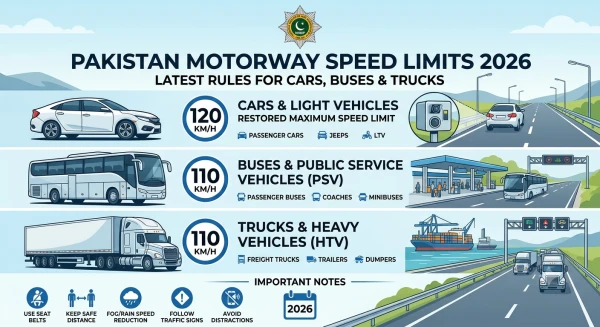
The NHMP guidelines have been updated to remove the temporary speed limits that were in place and reimplement the normal speed limits. These limits are in force except where a lower limit is shown on a particular section of the motorway.
Latest Speed Limit Table
|
Vehicle Type |
Maximum Speed Limit |
|
Private Cars |
120 km/h |
|
Light Transport Vehicles (LTVs) |
120 km/h |
|
Passenger Buses (PSVs) |
110 km/h |
|
Vans & Coasters |
110 km/h |
|
Trucks (HTVs) |
110 km/h |
|
Trailers & Heavy Commercial Vehicles |
110 km/h |
Observe speed signs, as there are some portions of the highway with reduced speed limits, such as construction sites, tunnels, bridges, foggy sections and accident-prone sections.
Why Did the Government Review Speed Limits?
In the past, the authorities had lowered the speed limits on the motorway and the highway in a short period of the year to conserve fuel and enhance traffic safety, but this time it was intended to be more permanent. Further assessment resulted in the government reinstating the previous motorway limits on reviewing the operational requirements and traffic conditions.
These reviews had the following main aims:
- Reducing serious accidents
- Improving fuel efficiency
- Enhancing traffic management
- Promoting better driving behavior
- Minimizing speeding violations
The speed limits are back in place but still enforced for speeding.
Why Speed Limits Are Important
It's quite common for many drivers to think that they are saving precious time by driving at a higher speed than the limit. In practice the time saved is often quite small, and the danger of loss in the process is often quite high.
Following motorway speed limits helps:
- Reduce accident severity
- Improve braking distance
- Lower fuel consumption
- Increase tire life
- Enhance passenger safety
- Reduce vehicle wear
The safe and economical way to drive is to do it within the limit.
Speed Limit for Private Cars
Private cars continue to be the top segment of vehicle traffic on Pakistan's motorways.
Maximum Allowed Speed: 120 km/h
This limit is for:
-
Sedans
-
Hatchbacks
-
SUVs
-
Crossovers
Light trucks are light-duty vehicles, such as pickup trucks, that are registered as light vehicles.
Although the following are exempt from slowing, drivers should still slow down during:
- Heavy rain
- Dense fog
- Poor visibility
- Road maintenance
- Heavy traffic
While the legal speed limit may be 120km/h, the condition of the road and weather are always a factor in safe driving.
Speed Limit for Buses
A dozen or more passengers may be on a passenger bus, where safety is even more important.
Maximum Allowed Speed: 110 km/h
Motorway Police are particularly alert to buses as fast speed can make an accident have serious repercussions.
Professional bus operators should:
- Keep a distance behind vehicles when following them
- Do not drive off of the road
- Don't suddenly change lanes
- Ensure drivers have required rest times
Speed Limit for Trucks
Heavy transport vehicles take longer to stop and are more difficult to turn at high speeds.
Maximum Allowed Speed: 110 km/h
In addition, truck drivers should:
- Secure cargo properly
- Keep safe distances
- Avoid unnecessary overtaking
- Operate in traffic in a safe and orderly manner.
These practices help improve safety for all motorway users.
Speed Limits on National Highways
It's important to note that motorway limits are different from national highway limits.
Lower limits are typically found on a national highway since highways have:
- Intersections
- Local traffic
- Motorcycles
- Pedestrians
- Agricultural vehicles
Do pay attention to road signs when moving from motorways onto highways.
Motorway Speed Cameras
The motorway network of Pakistan has adopted the advanced monitoring systems.
The speed is enforced using:
-
Automated cameras
-
Mobile patrol vehicles
-
Radar equipment
-
Digital monitoring systems
Challans and legal penalties can be given to drivers who flout the speed limits. Trying to ignore speed cameras could be dangerous and result in further infringements.
What Happens If You Exceed the Speed Limit?
An accident caused by exceeding the speed limit can lead to:
- Traffic fines
- Electronic challans
- Vehicle interception
- In more severe situations, a lawsuit is a possible alternative.
- Increased accident risk
If offenders continue to commit offences, there may be increased sanctions imposed. The simplest way to do this is to drive at a constant speed in the legal zone.
Common Motorway Driving Rules
In addition to speed restrictions, the following rules should be adhered to by motorists:
Always Wear Seatbelts
Sit up safely in your car seat. Use seat belts at all times. All passengers should be secured at all times.
Maintain Lane Discipline
Keep driving in the proper lane; do not change lanes unnecessarily.
Use Indicators
Use the signals before changing lanes and around another vehicle.
Keep a Safe Distance
Leave a safe distance to stop if the car in front stops quickly.
Avoid Mobile Phone Use
Don't use cell phones! Driving and talking on a cell phone are a bad mix.
Take Breaks on Long Trips
One of the most overlooked causes of motorway accidents is fatigue.
If driving for several hours:
- Stop every 2–3 hours
- Stay hydrated
- Stretch your legs
- Avoid driving while sleepy
Fuel Efficiency and Speed
There are several drivers who are in for a shock when they find out that a higher speed doesn't always save them money.
Aerodynamics are more significant at higher speeds and this typically results in higher fuel usage.
Driving smoothly and at a constant speed can:
- Reduce fuel consumption
- Extend engine life
- Lower maintenance costs
- Improve passenger comfort
Where possible, cruise control can also help to keep the speed of things consistent.
Driving During Fog
Winter is the season when fog frequently occurs, especially on the M-2.
If visibility drops:
- Slow down immediately
- Turn on fog lamps (if available)
- Increase following distance
- Avoid sudden braking
- Do not stop in the live traffic lane unless it is necessary
During heavy fog NHMP issues travel advisories on a regular basis.
Motorway Safety Tips
Before you start out on your trip:
- Check tire pressure
- Inspect brakes
- Be sure that light is functional.
- Check coolant and engine oil levels
- Always carry your driving licence and vehicle documents
- Pack Emergency Tools in Vehicle
With a few minutes' preparation, major problems can be avoided during long-distance travel.
Why Following Speed Limits Protects Everyone
Road safety is everyone's responsibility.
Obedient speed limits help, no matter what type of vehicle you are driving, such as a small hatchback, family SUV, passenger bus or heavy truck:
- Protect your passengers
- Reduce accident risks
- Improve traffic flow
- Save fuel
- Pioneer safer roads for all
Everyone who uses a motorway will benefit from responsible driving.
Conclusion
Pakistan's roads are one of the safest in the country as long as the rules of the road are adhered to. The standard speed limits have been reinstated at the 120 km/h rate for private cars and light transport vehicles and 110 km/h for buses and heavy transport vehicles (unless otherwise specified by road signs) as of the latest update in 2026.
Although it is important to arrive at your destination as quickly as possible, it is always important to arrive safely. By adhering to speed limits, being on the right lane, avoiding distractions and keeping your car in a good condition, you can help prevent accidents and make each trip on the motorway safer and more enjoyable.
FAQs
What is the motorway speed limit for cars in Pakistan in 2026?
On motorways, both private vehicles and light transport vehicles (LTVs) have a speed limit of 120 km/h (unless otherwise indicated).
What is the speed limit of buses?
The limit for passenger buses and other public service vehicles (PSVs) on the motorway is 110 km/h.
What should the speed limit be for trucks?
Heavy Transport Vehicles (HTVs) such as trucks are usually not allowed to exceed 110 km/h on motorways.
Is there any speed camera footage available on the motorway?
Yes. Automated cameras, radar systems and patrol units are used to monitor speed limits under the NHMP.
Are there any parts of the motorway where the speed limit is variable?
Yes. Some sections of the road may have reduced speed limits in construction areas, tunnels, inclement weather or other circumstances.
What will happen if I go over the speed limit?
Depending on how severe the violation is, an amount of fine, e-challans, vehicle interception, and legal action could be taken for overspeeding.
Comments 0
Share your thoughts with other readers. Let us keep the discussion respectful.